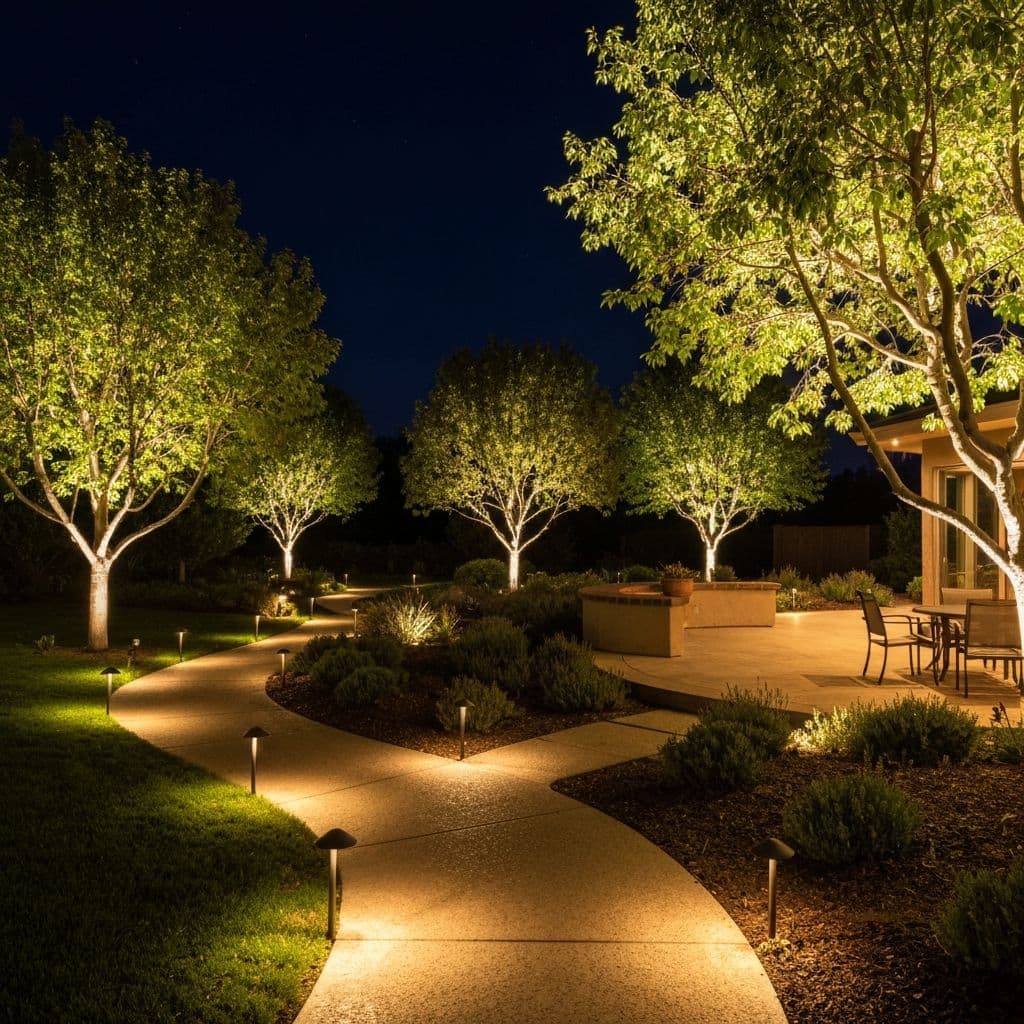
A typical Southern California backyard takes 18 to 30 low-voltage fixtures and lands between $3,000 and $12,000 installed. Estate properties in Hidden Hills or Rancho Santa Fe running 60 to 100 fixtures reach $15,000 to $35,000. The money is in solid brass housings and careful wiring, not in the lamps. Two specifications decide whether the result looks designed: one colour temperature throughout, and enough voltage at the far end of every run. Get either wrong and the yard looks patchy regardless of what you spent.
Light objects, not areas
The purpose is not brightness. It is contrast: lit forms against dark space.
Uplighting. Trees, walls, columns. Set the fixture 12 to 36 inches from the trunk for a tight beam, further out for a wash. Two fixtures at the base of a broad canopy read far better than one.
Downlighting, or moonlighting. Fixtures mounted 15 to 25 feet up in a canopy, casting leaf shadow across a patio. This is the most effective technique available on a mature oak or sycamore and the one homeowners never think of.
Path lighting. Eight to twelve feet apart, staggered, never lined up like a runway. A path light exists to reveal the path, not to be looked at.
Grazing and wall washing. A fixture 6 to 12 inches off a stone or stucco face, raking upward, reveals texture. Move it further out and the texture flattens.
Hardscape lighting. Under cap stones, under bench noses, under stair treads.
Pro Tip
If you can see the source from the house, you have made a mistake. Shroud it, recess it or aim it out of the sightline.
Fixtures, beam spreads and colour temperature
Material first. Solid cast brass or 316 stainless. Powder-coated aluminium fails within three to five years in coastal air from Malibu to Dana Point, as the coating lifts and the housing corrodes underneath. Brass patinas to a dull bronze; that is the material working as intended, not a defect.
Colour temperature is the difference between a professional system and a rental. Pick one and hold it: 2700K for traditional planting and warm stone, 3000K for contemporary work. Mixing temperatures across a yard is the most common amateur error and it is obvious from the house.
Beam spread by target: 10 to 15 degree spot for tall queen palms and narrow columns, 24 to 38 degrees for medium trees and wall accents, 45 to 60 degree flood for broad canopies and hedges.
Output: 2 to 4 watts for path lights, 4 to 7 watts uplighting a 15-foot tree, 9 to 12 watts for a 40-foot Canary Island date palm.
Ready to Start Your Project?
Schedule a free consultation with our design team.
Transformers, cable and voltage drop
This is where installations quietly fail.
Size the transformer to no more than 80 percent of its rating, so a 300-watt unit carries 240 watts of fixtures. Use a multi-tap stainless transformer with 12, 13, 14 and 15-volt taps.
LED fixtures want 10.5 to 12 volts at the lamp. Voltage falls along the cable, so a long daisy chain leaves the last fixtures dim and colour-shifted relative to the first. Two fixes: run 12-gauge or 10-gauge direct-burial cable rather than 14-gauge, and wire in hubs, meaning several short spokes from a central junction rather than one long chain. Then measure at the end of each run and move that run to a higher tap if it reads low.
As a rough planning limit, keep any single 12-gauge home run under roughly 100 watts and 100 feet, then verify with a meter.
Connections: silicone-filled direct-burial connectors or heat-shrink butt splices. Never a wire nut in soil.
Installation details and sequencing
Bury cable 6 inches deep, in conduit wherever it crosses under hardscape. Sleeve every driveway, patio and walkway crossing before base rock goes down. This is the single most-missed step on a remodel, and saw-cutting a finished paver driveway later costs many times what the sleeve would have.
Leave 6 to 8 feet of coiled slack at every tree fixture. Trunks expand and roots move; a tight cable strangles or severs itself within a few years.
Zone the system. Path and step lighting, tree uplighting and hardscape lighting on separate channels lets you run the safety lighting late, shut the display down, and dim each layer independently.
Control it with an astronomic timer or a smart controller so the schedule tracks sunset through the year instead of drifting. Where the property already has pool automation, landscape lighting can run off a relay in that same panel.
What it costs and what it needs afterwards
Installed pricing per fixture in the Los Angeles and Orange County market:
Cast brass path light, $180 to $350. Brass bullet uplight, $150 to $300. In-grade well light, $250 to $450, higher because it needs a drainage sump beneath it. Hardscape or under-cap light, $120 to $220. Tree-mounted downlight, $300 to $550, reflecting the climb and the cable dressing. Multi-tap transformer, $350 to $900 depending on capacity.
Maintenance is light but not zero. Re-aim fixtures twice a year as planting fills in; that is what keeps a system looking intentional in year five. Clean lenses seasonally, since salt film in coastal Newport Beach and dust in the inland valleys both cut output. Check connections after any irrigation or planting work.
Brass housings last twenty years or more. Integrated LED modules are typically rated near 50,000 hours, so expect the fixtures to outlive two light sources.
Final Thoughts
Landscape lighting is cheap to get wrong and not expensive to get right. Solid brass, one colour temperature, correct beam spreads, hub wiring with measured voltage at the far fixtures, and sleeves under every hardscape crossing. Budget $3,000 to $12,000 for a typical yard, and expect the housings to still be working in twenty years.
Frequently Asked Questions
Eighteen to thirty fixtures for a typical Southern California backyard. Count features rather than area: each specimen tree, each wall or column worth lighting, each set of steps, and path lights at 8 to 12 foot spacing along walkways. Larger estate properties commonly run 60 to 100 fixtures across front and rear yards.
2700K for traditional planting, warm stone and Spanish or Mediterranean architecture; 3000K for contemporary work and cooler stone. The specific number matters less than consistency. A yard with 2700K path lights and 4000K tree uplights looks unresolved from the house, and it is the most common giveaway of a piecemeal installation.
Voltage drop. On a long daisy chain the last fixtures receive noticeably less than 12 volts and dim, sometimes shifting colour as well. The fixes are heavier cable at 12 or 10 gauge, hub wiring with short spokes from a central junction, and moving low runs to a higher tap on a multi-tap transformer.
Typically $3,000 to $12,000 for a residential yard of 18 to 30 fixtures. Per fixture installed: $180 to $350 for a brass path light, $150 to $300 for an uplight, $250 to $450 for an in-grade well light, and $300 to $550 for a tree-mounted downlight, plus $350 to $900 for the transformer.
Yes, though hardscape crossings become the problem. Without pre-installed sleeves, cable has to be routed around patios and driveways or the surface has to be cut and reset. Adding sleeves during construction costs very little; retrofitting a single driveway crossing afterwards can cost more than several fixtures.