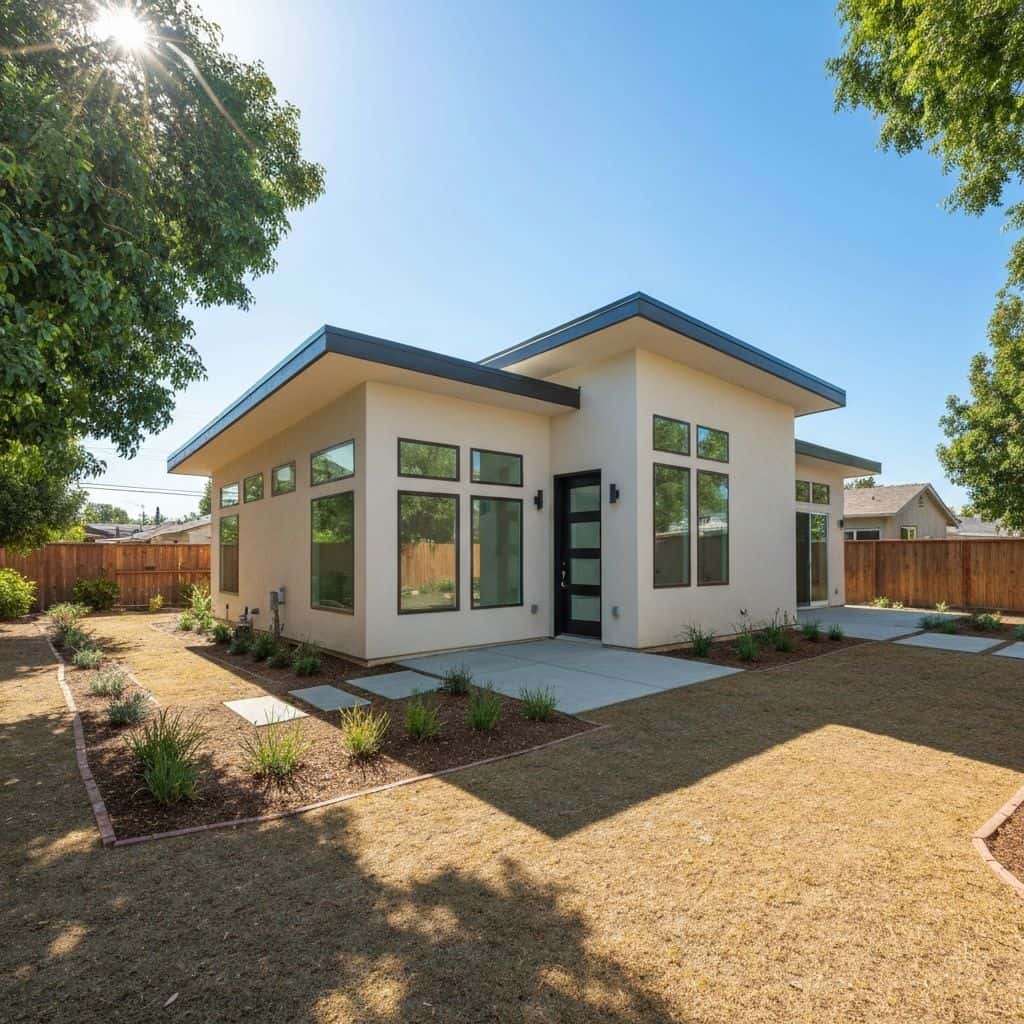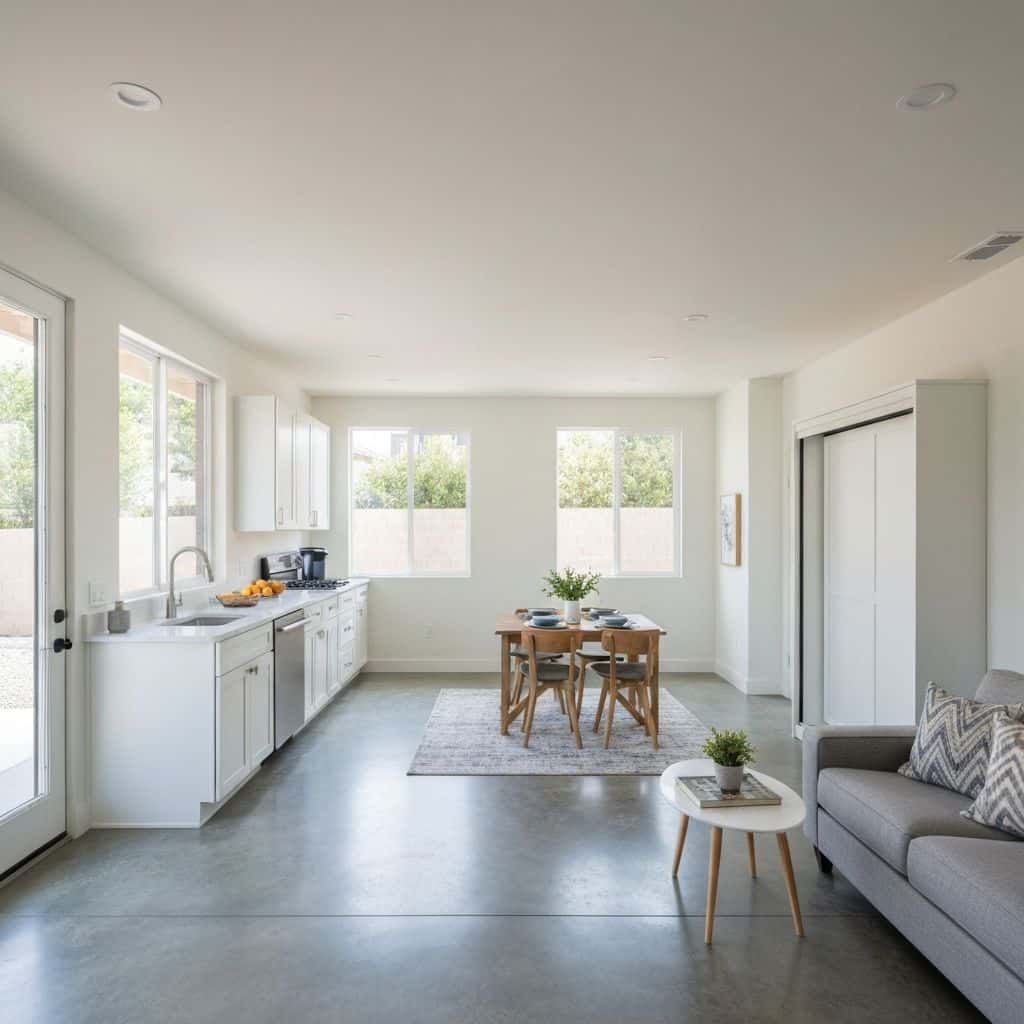
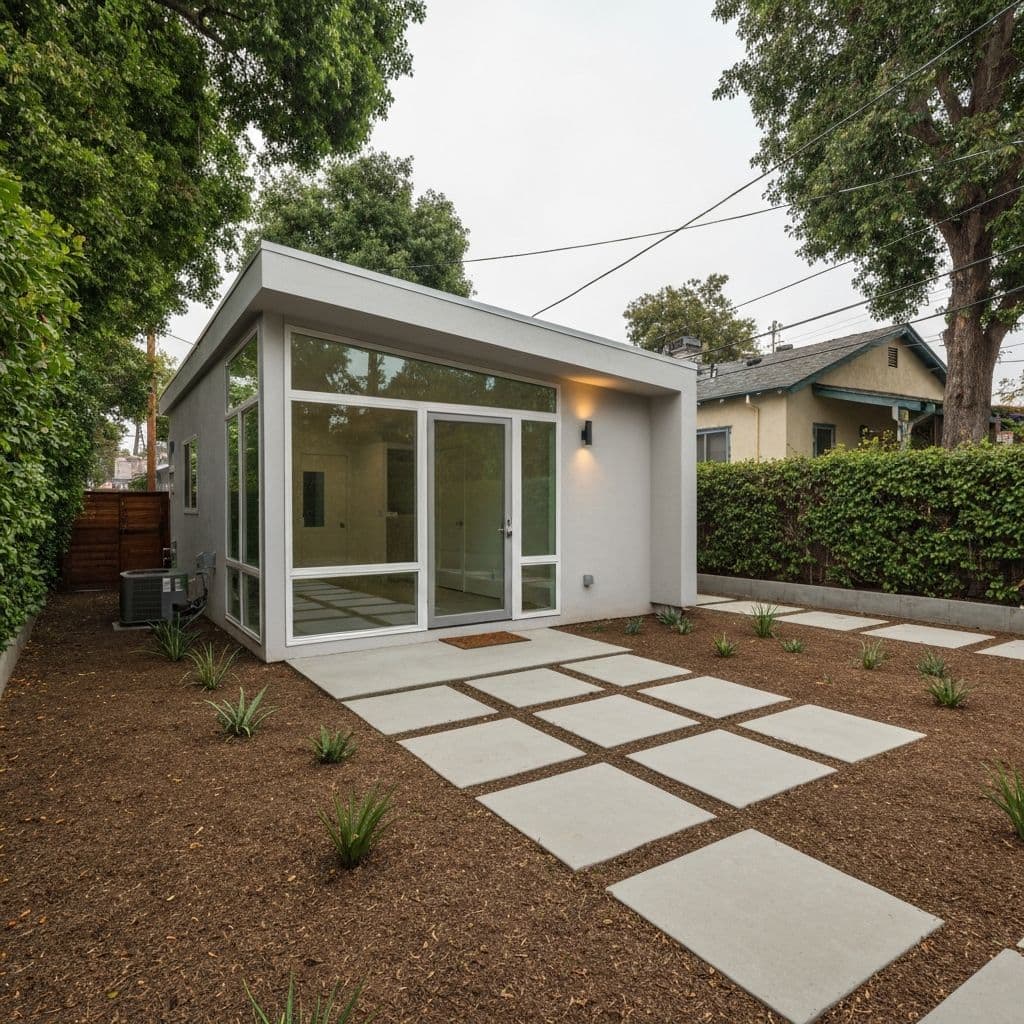
A garage conversion ADU in Granada Hills costs $95,000 to $180,000. A detached new-build ADU runs $180,000 to $400,000 depending on size and finish. Granada Hills is well suited to ADUs. The tracts north of Devonshire and the older parcels around Zelzah and Balboa carry deep lots with genuine rear-yard room, and many have a detached garage already sitting where an ADU wants to go. What complicates it is infrastructure age. A lot of Granada Hills housing stock is 1950s and 1960s with 100A service, undersized sewer laterals, and in the equestrian pockets up toward the foothills, occasional septic and horse-keeping overlays that affect siting.
Garage conversion versus detached build: the honest comparison
Garage conversion. A typical Granada Hills detached two-car garage is 400-440 sq ft. Converting it gives you a studio or a tight one-bedroom. Cost runs $95,000 to $180,000, or roughly $240-$400/sq ft. You are paying for: new foundation work or slab repair, raising the slab above grade where required, framing new walls to code, insulation to Title 24, windows and egress, a full bathroom and kitchen, HVAC, and separate utilities. The existing walls save less money than people expect. Many garages have no footing under the perimeter that will carry a habitable structure.
Detached new build. 600-800 sq ft, two bedrooms, runs $180,000 to $400,000, or roughly $300-$500/sq ft. You get proper ceiling heights, a layout that works, real insulation, and a building that appraises cleanly.
The decision rule: if the garage is structurally sound, the slab is serviceable, and you want 400-450 sq ft, convert. If you want two bedrooms or more than about 550 sq ft, build detached. The cost per square foot converges quickly and the detached building is a better asset.
Attached ADUs and junior ADUs carved from existing house area sit between the two, typically $110,000-$220,000.
Pro Tip
Have the garage slab and perimeter footing inspected before you commit to conversion. Discovering there is no footing after design is a $25,000 surprise.
Electrical, sewer and the infrastructure most people miss
This is where Granada Hills ADU budgets break.
Electrical service. A 1958 tract house with 100A service cannot carry a second dwelling. You have two paths: upgrade the main to 200A or 225A and feed a sub-panel to the ADU ($4,500-$9,000 including the ADU feeder and trench), or install a separate service with its own meter ($8,000-$18,000 depending on LADWP requirements and distance from the transformer). Separate metering is worth it if you plan to rent, because you can bill utilities cleanly.
Sewer. Older laterals in this area are frequently 4 in clay, sometimes root-intruded. Adding an ADU means a new lateral connection or a tie-in with a cleanout. Budget $4,000-$14,000. A camera inspection of the existing lateral costs $250-$500 and is the best money in the whole project.
Septic. Parts of the Granada Hills foothills (the equestrian-zoned pockets up near the Santa Susana edge) remain on septic. An ADU on septic requires a system evaluation and often an expansion or replacement. That is $25,000-$70,000 and can be the deciding factor on whether the project pencils.
Water and gas. A 3/4 in service commonly needs upsizing to 1 in for a second dwelling. Gas line extension for the ADU: $2,000-$5,000.
Pro Tip
Camera the sewer lateral in week one. A collapsed clay line discovered at rough plumbing stops the job for weeks.
Ready to Start Your Project?
Schedule a free consultation with our design team.
The LADBS path and the code that governs it
ADUs in the City of Los Angeles are governed by LA ADU Ordinance 186,481, codified at LAMC 12.22 A.33, alongside state ADU law. Permitting runs through LADBS.
What you submit: site plan with setbacks, existing and proposed floor plans, elevations, structural plans and calculations, Title 24 energy compliance documentation, and the utility scope. LADBS also runs the plan through the relevant clearances: planning, fire, and grading where applicable.
Points that shape design:
- Rear and side setbacks for detached ADUs are limited under state law, which is why detached units so often sit in the rear corner.
- Height limits apply and vary by configuration; a single-storey detached unit avoids most of the argument.
- Fire separation between the ADU and the main house drives wall assemblies and window placement when the buildings sit close.
- California Title 24 energy standards apply in full: insulation values, fenestration performance, HVAC efficiency, and the solar requirement for qualifying new construction. Budget $12,000-$25,000 for a compliant solar array where it is triggered, though existing-house offsets and exemptions can apply.
- Hillside parcels in Granada Hills may also engage Baseline Hillside Ordinance 184,802 for grading and envelope.
Construction duration: 4 to 7 months for a garage conversion, 6 to 11 months for a detached build. Design and plan check happen before that and vary.
Pro Tip
Bring the Title 24 consultant in at schematic design. Fixing fenestration ratios after elevations are drawn means redrawing elevations.
Detached ADU cost breakdown for a 750 sq ft unit
A realistic Granada Hills line-item budget for a two-bedroom, one-bath, 750 sq ft detached ADU:
- Design, structural engineering, Title 24, permit fees: $18,000-$35,000
- Site work, grading, utility trenching: $10,000-$25,000
- Foundation, slab on grade with turned-down footings: $18,000-$30,000
- Framing, sheathing, roof structure: $35,000-$55,000
- Roofing, Class A assembly: $8,000-$16,000
- Windows and exterior doors: $9,000-$20,000
- Stucco or fibre cement siding: $12,000-$22,000
- Rough plumbing, electrical, HVAC (mini-split or small ducted system): $30,000-$50,000
- Insulation and drywall: $12,000-$20,000
- Kitchen, cabinets, counters, appliances: $14,000-$32,000
- Bathroom: $9,000-$18,000
- Flooring, interior doors, trim, paint: $14,000-$28,000
- Utility connections, sewer, water, gas, electrical service: $12,000-$30,000
- Solar where required by Title 24: $12,000-$25,000
Range: roughly $213,000 to $406,000. The lower end assumes a straightforward flat site, existing 200A service, and mid-grade finishes. Granada Hills lots generally cooperate on the site side, which helps.
Pro Tip
Spec a ducted mini-split rather than a wall cassette if the budget allows. It costs $4,000-$8,000 more and materially improves how the unit rents.
Siting an ADU on a Granada Hills lot
Typical Granada Hills tract lots run 7,500 to 12,000 sq ft with rear yards 50 to 80 ft deep. The older parcels off Zelzah, and the equestrian-zoned properties near the foothills, run considerably larger.
Siting principles that hold here:
Keep separation. Even where setbacks allow tight placement, leaving 10-15 ft between the ADU and the main house preserves light, privacy and outdoor space for both. It also simplifies fire separation requirements.
Give each unit its own outdoor space. A 12 x 16 ft private patio for the ADU with a screen or planting divide is inexpensive ($4,000-$9,000) and it is what makes the arrangement livable long-term.
Independent access. A side-yard path from street to ADU door means tenants never cross the main house's yard. Where the side yard is 5 ft or less, this is the constraint that dictates which side the ADU sits on.
Utility routing. Site the ADU so the sewer run to the existing lateral is short and downhill. Every 20 ft of added sewer trench through finished hardscape is real money.
Equestrian pockets. In the horse-keeping areas near the foothills, existing stables, corrals and required animal-keeping setbacks affect where a structure can go. Check what the property is entitled to keep before designing over it.
Pro Tip
Mock the ADU footprint on the ground with stakes and string before drawings are finalised. It reveals privacy and access problems no plan view shows.
What an ADU returns and where the plan goes wrong
An ADU is a long-hold asset, not a quick flip. Granada Hills sits in a rental market where a well-built one-bedroom detached unit commands meaningful monthly rent, and a two-bedroom more. Run your own numbers with current comparable listings rather than trusting a builder's projection. Anyone quoting you a guaranteed rent figure is selling, not advising.
The three ways ADU projects go wrong here:
Budgeting only the building. The building is 65-75 percent of the cost. Utilities, service upgrade, sewer, site work and permit fees are the rest, and they get discovered late.
Converting a garage that should not be converted. A 1955 garage with a 3 in slab, no perimeter footing and a sagging roof structure costs more to make habitable than a new build costs to erect. Get it assessed.
Ignoring parking and access reality. Converting the garage removes covered parking. On streets with restricted overnight parking, that matters to you and to future buyers. Think it through before demolition.
One more: undersizing the kitchen. A 750 sq ft unit with a real kitchen (10 linear feet of counter, full-size range and refrigerator) rents differently from one with a kitchenette. The cost delta is $6,000-$12,000.
Pro Tip
Meter the ADU separately if you intend to rent. It removes the single most common landlord-tenant argument at almost no extra construction cost.
Final Thoughts
Granada Hills is one of the better ADU markets in the Valley because the lots have real depth and the siting problems are solvable. The costs that surprise people are underground and in the panel, not in the building. Budget $95,000 to $180,000 for a garage conversion and $180,000 to $400,000 for a detached unit, camera the sewer and assess the electrical service before design, and confirm whether your parcel sits on septic or in an equestrian overlay. Everything after that is normal construction.
Frequently Asked Questions
A garage conversion runs $95,000 to $180,000, roughly $240 to $400 per square foot. A detached new-build ADU of 600 to 800 square feet runs $180,000 to $400,000, roughly $300 to $500 per square foot. Utility upgrades, sewer work and permit fees typically account for 25 to 35 percent of the total.
ADUs in the City of Los Angeles fall under LA ADU Ordinance 186,481, codified at LAMC 12.22 A.33, alongside state ADU law, with permits issued by LADBS. California Title 24 energy standards apply in full, including insulation, fenestration performance, HVAC efficiency and the solar requirement for qualifying new construction.
Usually. Much of the 1950s and 1960s housing stock carries 100A service, which cannot support a second dwelling. Upgrading the main to 200A or 225A with a sub-panel feed to the ADU runs $4,500 to $9,000. A fully separate service with its own meter runs $8,000 to $18,000 and is worth it for rentals.
Convert if the garage is structurally sound with a serviceable slab and perimeter footing, and you want 400 to 450 square feet. Build detached if you want two bedrooms or more than about 550 square feet. Cost per square foot converges quickly and a detached building appraises better and offers proper ceiling heights.
Construction runs 4 to 7 months for a garage conversion and 6 to 11 months for a detached new build. Design, structural engineering, Title 24 documentation and LADBS plan check happen before that window and vary by project scope. Utility work and service upgrades can extend the schedule if discovered late.