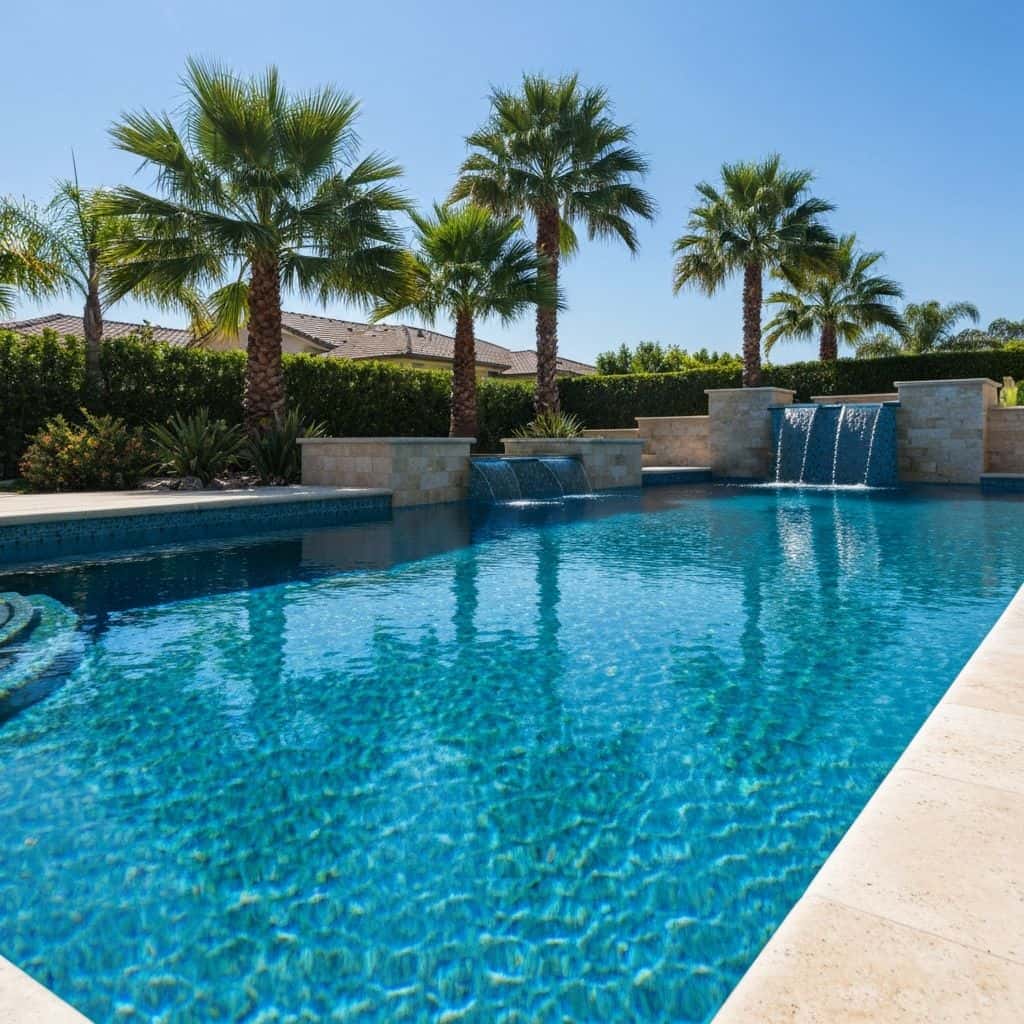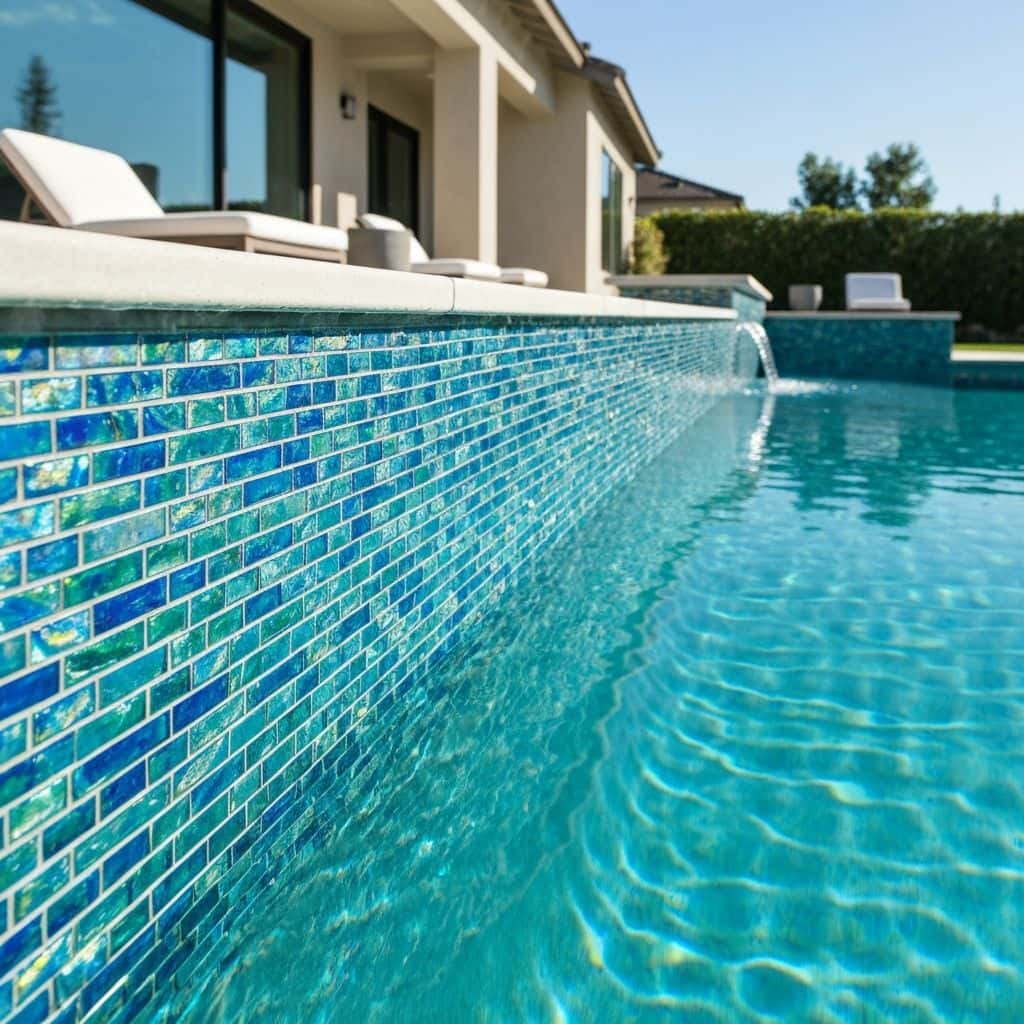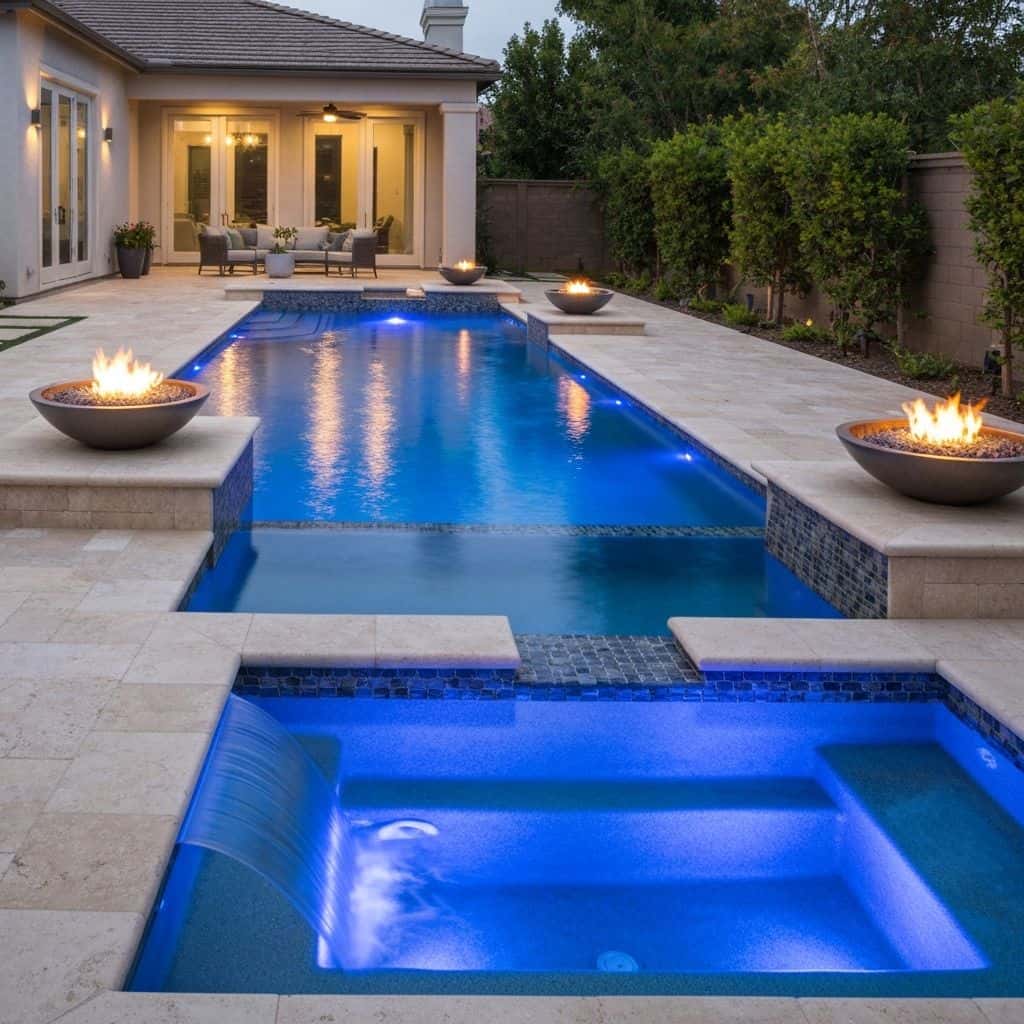
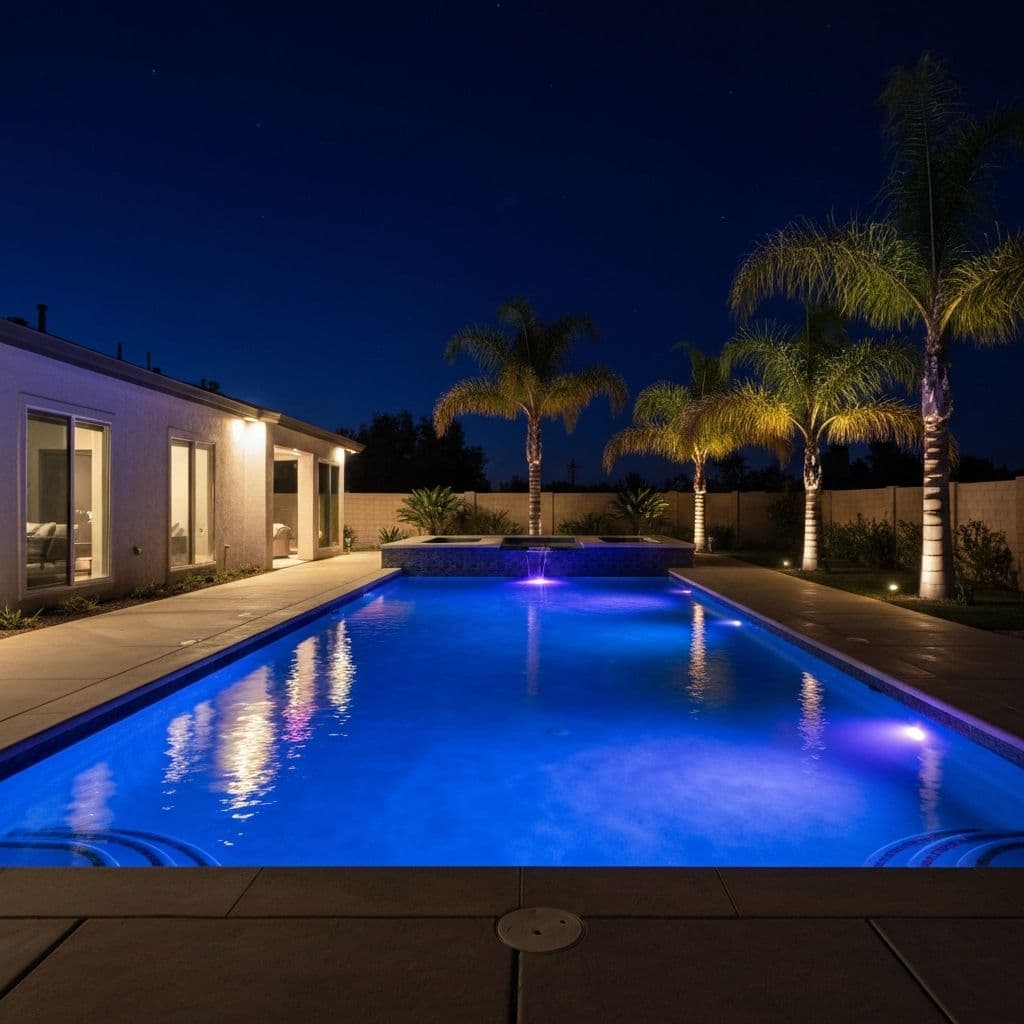
Plan one colour-changing LED for every 250 to 350 square feet of pool surface. A 15 by 30 pool, 450 square feet, reads properly with two fixtures, not one. Swapping a colour LED into an existing niche runs $700 to $1,400 per light installed. A nicheless LED on a new build is $400 to $800 for the fixture plus wiring. The bigger variable is the interior finish: a dark pebble shell absorbs light and needs an extra fixture to look the same as a white one.
Fixture count and placement
Count by surface area first: one 12-volt colour LED per 250 to 350 square feet. A 12 by 24 pool takes one. A 15 by 30 takes two. A 20 by 40 with a raised wall takes three, plus one in the spa.
Placement decides whether the pool looks lit or looks glary. Put fixtures on the wall that the main viewing position faces away from, usually the house-side wall, so light throws away from the patio. A light aimed back at the dining terrace turns the surface into a glare sheet and hides the water underneath it.
Set the fixture centre 12 to 18 inches below the waterline for a full-size niche. Higher than about 8 inches and the beam breaks the surface and scatters. Deeper than 24 inches and you lose the wash across the shallow end.
In a spa, one small nicheless fixture per bench alcove gives even light; a single central light simply backlights whoever sits opposite.
Pro Tip
Aim lights away from where people sit. Surface glare is the most common lighting complaint we are asked to fix.
What LED pool lighting costs
Retrofit into an existing wet niche: $700 to $1,400 per light installed. The fixture is $450 to $900 and the balance is labour, which covers pulling the old lamp, checking conduit and cord length, and testing bonding and the transformer.
New construction with nicheless LEDs: $400 to $800 per fixture, plus conduit, bonding and a listed 12-volt transformer at $350 to $900 depending on capacity.
Colour-changing costs more than white-only, typically $150 to $350 per fixture. On a pool with a mid-tone blue finish and strong landscape lighting already in the yard, white-only is a defensible saving.
Running cost is where LEDs pay. An old 300 to 500 watt incandescent pool lamp running six hours a night burns roughly 650 to 1,100 kilowatt-hours a year. At Southern California residential electricity rates that is real money every season. A 40-watt colour LED doing the same job costs under a tenth as much to run.
Ready to Start Your Project?
Schedule a free consultation with our design team.
Colour temperature, colour control and how the finish changes it
Pool LEDs sold as white are usually 5,700K to 6,500K, which is cool and bright. That reads clean against white plaster and blue quartz. It reads cold and faintly green against a warm tan pebble. If the shell is a light sand or beige finish, a warmer white nearer 4,000K keeps the water looking like water rather than like a screen.
Interior finish is the biggest single variable. Midnight-blue and charcoal pebble absorbs a large share of the output. A dark pool needs one more fixture than the surface-area rule suggests, or it will look dim no matter what wattage you buy. That is a design decision to make at the same time as the finish, not afterwards.
Colour-changing fixtures cycle through fixed shows and solid colours. Without an automation system, colours are selected by counting power interruptions at the switch, so every light on that circuit must be switched together or they fall out of sync.
Wiring, bonding and what an inspector checks
Pool lighting is regulated electrical work and in California it is inspected. Three requirements come up on every job.
A listed low-voltage supply. Twelve-volt fixtures are fed from a listed transformer or power supply with GFCI protection, and the disconnect and receptacle locations are set by code relative to the water.
Equipotential bonding. The wet niche, all metal fixture parts, the shell steel, the perimeter deck surface, ladders, handrails and the equipment pad are bonded together with a solid 8 AWG copper conductor. This is the item most often found missing on older pools during a remodel, and it is not optional.
Serviceable cord length. There must be enough cord coiled in the niche to lift the fixture onto the deck for service without splicing. Retrofit kits that shorten the cord cause a failed inspection.
Use a licensed electrician and pull the permit. This is a fixture sitting in water that people stand in.
Retrofitting an older pool
Most Southern California pools built before roughly 2010 have a single 300 or 500 watt incandescent light in a 10-inch niche. There are three practical paths.
Lamp-only LED retrofit. A colour LED lamp assembly into the existing niche and housing, $700 to $1,400 installed. Cheapest, keeps the existing conduit, and works if the niche, cord and bonding all check out.
Full fixture replacement. Necessary when the niche is corroded, the conduit is compromised or the cord is short. Add $400 to $900.
Add a second fixture. This is the one homeowners skip and later regret. A new niche in an existing shell means cutting the wall, running conduit and patching, so it only makes sense during a remodel when the pool is drained and the deck is open. Budget $2,000 to $4,500 for a second light added at that stage.
Final Thoughts
Count fixtures by surface area, add one for a dark interior finish, aim them away from where people sit, and hold a single colour temperature across the water. Then have the wiring done by a licensed electrician under permit, because bonding is what makes a pool light safe. Good lighting is what turns a pool from a daytime feature into an evening one.
Frequently Asked Questions
One 12-volt colour LED per 250 to 350 square feet of water surface, plus one in any attached spa. A 12 by 24 pool takes one, a 15 by 30 takes two, a 20 by 40 takes three. Add one extra fixture if the interior finish is a dark pebble, because dark aggregate absorbs a substantial share of the output.
They add $150 to $350 per fixture over white-only. Worth it if the pool is a focal point from indoors or the yard is used for entertaining. Less compelling on a lap pool or where landscape lighting already carries the scene. Note that without automation, colours are selected by switching power on and off in a set pattern.
No. It is permitted electrical work in California, and the parts that matter are the ones you cannot see: equipotential bonding of the niche and shell steel, GFCI protection, a listed low-voltage supply and adequate cord length in the niche for servicing. Have a licensed electrician do it and have it inspected.
Yes, measurably. A 300 to 500 watt incandescent running six hours a night uses roughly 650 to 1,100 kilowatt-hours per year. A 40-watt colour LED doing the same duty uses under 90. At Southern California residential rates the fixture cost is typically recovered within a few seasons, before counting the lamp replacements you no longer buy.