
An aluminium louvered pergola costs $18,000 to $40,000 installed. A wood pergola costs $9,500 to $22,000. A shade sail costs $2,500 to $8,000. They are not three prices for the same thing. A shade sail blocks sun over a play area. A wood pergola defines a space and casts partial shade. A louvered system gives you full sun, full shade or rain cover on command, which is the only one of the three that makes a Southern California patio genuinely usable at one in the afternoon in July. Here is how to choose.
What each costs, and what that buys
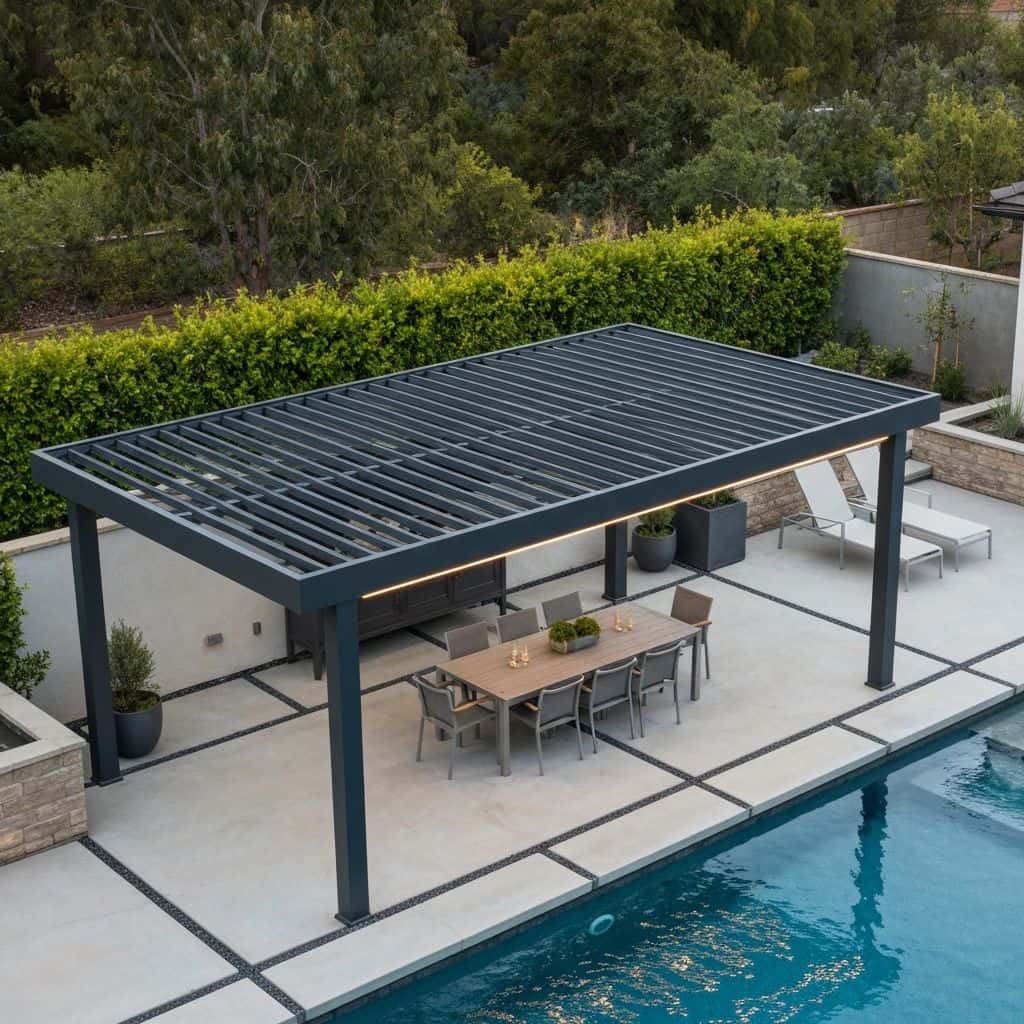
A shade sail at $2,500 to $8,000 buys knitted HDPE fabric blocking 90 to 95 percent of UV, three or four anchor points on 4x4 steel or 6x6 wood posts in 18 to 24 inch diameter footings, 36 to 42 inches deep, with turnbuckle tensioning. A wood pergola at $9,500 to $22,000 typically buys a 12 by 16 foot to 16 by 20 foot structure in Douglas fir or western red cedar: 6x6 posts, doubled 2x10 or 2x12 beams, 2x6 rafters at 16 to 24 inches on center, and either open rafters or an added slat top. An aluminium louvered pergola at $18,000 to $40,000 works out to roughly $85 to $150 per square foot of covered area, and includes an extruded frame, motorized louvers rotating through about 160 degrees, integrated gutters and downspouts hidden in the posts, and a rain sensor.
Pro Tip
Price louvered systems by covered square foot, not by unit. A 14 by 20 and a 16 by 24 can look similar on a proposal and differ by $9,000.
How much shade you actually get
This is the number nobody quotes and the one that determines whether the space gets used. An open rafter wood pergola with 2x6 rafters at 24 inches on center blocks roughly 25 to 35 percent of direct sun at midday. It looks like shade in a photograph and does very little in Woodland Hills in August. Tighten to 2x2 slats at 3 inch spacing and you reach 50 to 65 percent, at the cost of a heavier structure and more footing. A shade sail blocks 90 to 95 percent of UV under the fabric, but the shade moves across the yard through the day, so a sail that covers a trampoline at noon leaves it exposed at four. A louvered pergola closes to effectively 100 percent and opens to zero, which is the entire argument for the price. In closed position with sealed louvers it also sheds rain.
Ready to Start Your Project?
Schedule a free consultation with our design team.
Permits, footings and hillside lots
In most Southern California jurisdictions a patio cover over 120 square feet requires a building permit, and anything attached to the house requires a structural connection detail: a properly flashed ledger lagged into rim joists or blocking, not into stucco. Freestanding structures still need engineered footings sized for uplift and lateral wind, which is why a $3,000 online pergola kit set on surface blocks is both unpermittable and a liability in a Santa Ana wind event. Larger louvered systems and clear-span wood structures usually come with manufacturer or engineer calculations, and those calculations are what plan check reviews. On hillside lots in Los Angeles, the Baseline Hillside Ordinance 184,802 governs how a covered structure counts against allowable floor area and lot coverage, so a patio cover can consume square footage you were saving for an addition. Motorized louvers also need a dedicated 120 volt, 20 amp circuit.
Maintenance over ten years
Aluminium is the low-maintenance option by a wide margin. A quality powder-coated extrusion holds finish for fifteen years or more, and annual maintenance is rinsing the louvers and clearing the integrated gutters. Motors and sensors are the wear items; budget for a service visit every few years. Wood is the opposite. Cedar and Douglas fir in Southern California sun need refinishing every two to three years at $2 to $4 per square foot of structure, and skipping two cycles means graying, checking and eventually rot at the post bases and beam ends. Posts set directly in concrete without standoff bases are the most common failure we open up. Shade sail fabric is consumable: five to ten years of SoCal UV before it slackens and thins, with replacement fabric at $600 to $2,000. Sails should also be taken down before major wind events, which people do not do.
What we recommend for each situation
Specify an aluminium louvered pergola over an outdoor kitchen or a dining table, anywhere you want to commit furniture, appliances and a rug to a spot and use it at midday. It is expensive and it is the only one of the three that turns an unusable patio into a room. Specify a wood pergola when the goal is architectural character on a Spanish, Craftsman or ranch house, where partial shade is enough, and where the owner is genuinely willing to refinish it. Build it properly: standoff post bases, tight slat spacing, and a stain rather than a film-forming paint. Specify a shade sail for play areas, side yards, dog runs and trampolines, or as a deliberate two-year stopgap while the rest of a backyard budget is spent on hardscape and a pool. It is the only one of the three that is easy to remove.
Pro Tip
If a louvered pergola is the eventual goal but not this year's budget, set the footings and posts now while the hardscape is open. Retrofitting footings through finished pavers costs thousands.
Final Thoughts
Shade sails are cheap, fast and temporary. Wood pergolas look right on the right house and demand refinishing every two to three years. Aluminium louvered systems cost the most and are the only option that makes a patio usable in full afternoon sun and light rain. Match the choice to how many hours a week you actually intend to sit there.
Frequently Asked Questions
Between $18,000 and $40,000 installed for typical residential sizes, working out to roughly $85 to $150 per square foot of covered area. That includes the extruded frame, motorized louvers, integrated gutters in the posts, engineered footings and a dedicated 120 volt circuit. Heaters, LED lighting, retractable screens and larger clear spans push toward and past the top of the range.
In most jurisdictions, yes, once a patio cover exceeds 120 square feet, and always if it attaches to the house. Attached structures need an engineered ledger connection and flashing detail; freestanding ones need footings sized for wind uplift. On hillside lots the Baseline Hillside Ordinance 184,802 also governs how the structure counts against lot coverage and allowable floor area.
Less than people expect. Standard 2x6 rafters at 24 inches on center block roughly 25 to 35 percent of direct midday sun. Adding a slat top with 2x2 members at about 3 inch spacing raises that to 50 to 65 percent but requires heavier beams and footings. If you want real midday shade, you want louvers, a solid roof or dense slats.
Five to ten years under Southern California UV before knitted HDPE fabric slackens, thins and starts to tear at the corners. Replacement fabric runs $600 to $2,000 depending on size and shape. Sails should also be dropped before Santa Ana wind events. The fabric transfers enormous load into the anchor posts, which is how footings get pulled.
If the space sits under afternoon sun and you plan to put an outdoor kitchen, dining table or seating group there, yes. Louvers convert an unusable patio into a room you can occupy at any hour and keep dry in light rain. If the structure is decorative, frames a walkway or shades an already-cool north side, a wood pergola at half the price is the sensible choice.