A 125,000 BTU pool heat pump costs $6,000 to $11,000 installed in Southern California. A 400,000 BTU natural gas heater costs $3,500 to $6,500. Gas raises a 15,000 gallon pool about 2.7 degrees an hour; the heat pump manages about one degree. On running cost, the heat pump is cheaper, but at California electricity rates the margin is roughly 20 to 30 percent, not the three-to-one savings often quoted. Here is the arithmetic, the equipment requirements, and how we actually specify heating on a Southern California backyard.
What each system costs to install
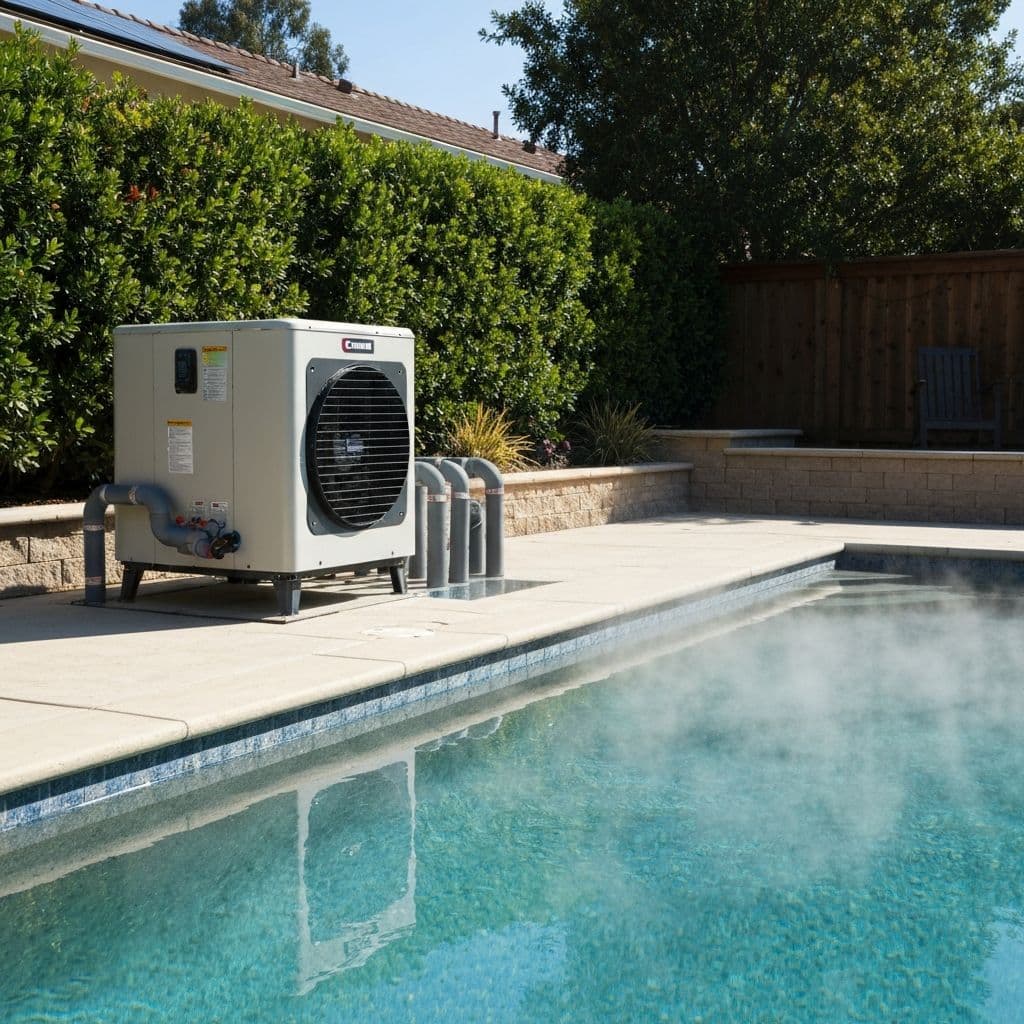
A 400,000 BTU natural gas heater is $2,600 to $4,500 for the unit, plus $900 to $2,500 for the gas work and electrical connection. Figure $3,500 to $6,500 all in. The variable is gas supply: at $18 to $35 per lineal foot for a properly sized 3/4 inch or 1 inch run, a long run from the meter to a back-corner equipment pad adds real money, and a 400,000 BTU load on top of an existing furnace, range and dryer can exceed meter capacity and require a utility upgrade. A 125,000 BTU heat pump is $4,500 to $7,500 for the unit and $1,500 to $3,500 for a dedicated 240 volt, 50 to 60 amp circuit. If the main panel is full or under 150 amps (common on 1960s houses in Long Beach or Pasadena) add $3,500 to $8,000 for a panel upgrade.
Pro Tip
Before you price either heater, photograph your main electrical panel and your gas meter. Those two photos determine half the install cost.
How fast each one actually heats
This is where gas is unmatched. A 400,000 BTU heater at 84 percent thermal efficiency delivers about 336,000 BTU per hour into the water. A 15,000 gallon pool weighs roughly 125,000 pounds, and one BTU raises one pound of water one degree. So gas moves that pool about 2.7 degrees per hour. A 125,000 BTU heat pump delivers about one degree per hour under favorable conditions. Taking a 68 degree pool to 84 degrees is about six hours on gas and around sixteen on the heat pump. For a spa the gap is decisive: a 500 gallon spa on a gas heater is ready in 30 to 45 minutes, while a heat pump takes hours and is not a realistic spa solution. Heat pumps are designed to hold a temperature continuously, not to heat on demand for Saturday guests.
Ready to Start Your Project?
Schedule a free consultation with our design team.
Cost per million BTU at real SoCal rates
Work in dollars per million BTU delivered and the comparison stops being vague. Gas: 400,000 BTU input is 4 therms per hour, delivering 336,000 BTU. That is about 11.9 therms per million BTU delivered. At $2.20 per therm, roughly $26 per million BTU. Heat pump: at a coefficient of performance of 5.5 in 80 degree ambient air, a 125,000 BTU unit draws about 6.7 kW, so a million BTU takes about 53 kWh. At $0.38 per kWh, roughly $20 per million BTU, about 23 percent cheaper. Now run it on a 50 degree January morning in Santa Clarita, where COP falls to around 3.2: the same million BTU takes about 91 kWh, roughly $35, and gas wins. Heat pump economics in California depend entirely on ambient temperature and your electricity tier.
Where you live changes the answer
Coastal Southern California is the best heat pump territory in the country. Overnight lows in Newport Beach, Santa Monica and Carlsbad rarely fall far enough to collapse COP, so a heat pump runs efficiently nine to eleven months a year. Inland valleys are more mixed: Woodland Hills and Rancho Cucamonga are excellent from April through October and poor on winter mornings, which is when a homeowner who wants a heated pool in January discovers the limit. Whatever the equipment, the cheapest BTU is the one you do not lose. Evaporation is the dominant heat loss in an uncovered pool, and a liquid or solid cover materially reduces it. Solar heating is worth pricing alongside both: $4,000 to $9,000 for a panel array needing roof area equal to roughly 50 to 80 percent of pool surface, with essentially no running cost and no ability to heat on demand.
Pro Tip
An automatic or solar cover pays back faster than any heater upgrade. Nothing else cuts pool heating cost by that percentage for that price.
Code, controls and the equipment pad
California Title 24 energy standards set minimum efficiency and control requirements for pool heating equipment and circulation systems, and state appliance efficiency rules mean any meaningful replacement pump will be a variable-speed model. That matters here: heaters and pumps are specified together, since a variable-speed pump running low RPM for filtration has to be programmed to step up to the heater's minimum flow rate when heating, or the heater will short-cycle on its pressure switch. Both heater types need clearances: gas needs combustion air and a listed vent termination away from openings and property lines, heat pumps need free airflow on all sides and above and produce fan noise plus condensate that has to drain somewhere. On a permitted pool build or remodel in Los Angeles, this equipment falls under the LADBS combined Building-Mechanical permit for private pools. Plumbing plan check applies to commercial and apartment pools, not single-family.
What we specify
If the project is pool only, the owner swims regularly through the season, the house is coastal or the pool is used mostly April to October, specify a heat pump plus an automatic cover. It is the lower operating cost and the lower-carbon path, and the slow heat rate is irrelevant when you are holding a temperature rather than chasing one. If there is a spa, specify gas. A heat pump cannot deliver a spa on demand and no amount of sizing changes that. For the majority of Southern California backyards with a pool and an attached spa, the correct answer is both: a heat pump maintaining the pool and a gas heater dedicated to the spa, plumbed with automation valves, at roughly $11,000 to $17,000 combined. That combination costs more up front and is the setup owners are still happy with in year five.
Final Thoughts
Gas is cheaper to install, heats nearly three times faster and is the only realistic way to run a spa. A heat pump costs more up front and runs roughly 20 to 30 percent cheaper per BTU in warm ambient air, though that advantage inverts on cold inland mornings. If your yard has both a pool and a spa, run a heat pump for the pool and gas for the spa and stop compromising.
Frequently Asked Questions
Usually, but by less than most people expect. At around $2.20 per therm for gas and $0.38 per kWh for electricity, a heat pump costs roughly $20 per million BTU delivered against about $26 for gas, a 23 percent saving. On a cold inland morning, when the heat pump's efficiency falls, gas becomes the cheaper option.
About one degree per hour for a 125,000 BTU unit on a 15,000 gallon pool in warm ambient air. Taking that pool from 68 to 84 degrees takes roughly sixteen hours. A 400,000 BTU gas heater does the same job in about six hours. Heat pumps are designed to hold temperature, not to heat on demand.
Not practically. A gas heater brings a 500 gallon spa up to temperature in 30 to 45 minutes; a heat pump takes several hours, which defeats the purpose of a spa. If your yard has a spa, specify gas for it. The common solution is a heat pump maintaining the pool and a dedicated gas heater for the spa.
Often, yes. A 125,000 BTU heat pump typically needs a dedicated 240 volt circuit at 50 to 60 amps. Houses with a 100 or 125 amp main panel, common in older Los Angeles and Long Beach neighborhoods, usually cannot carry that alongside existing loads. A panel upgrade adds $3,500 to $8,000 to the project.
Yes, as a supplement. A solar array runs $4,000 to $9,000 installed and needs unshaded roof area equal to roughly 50 to 80 percent of your pool's surface. Operating cost is effectively zero. The limitation is control: it heats when the sun is out, not when you decide to swim, so most owners pair it with a gas heater for on-demand use.