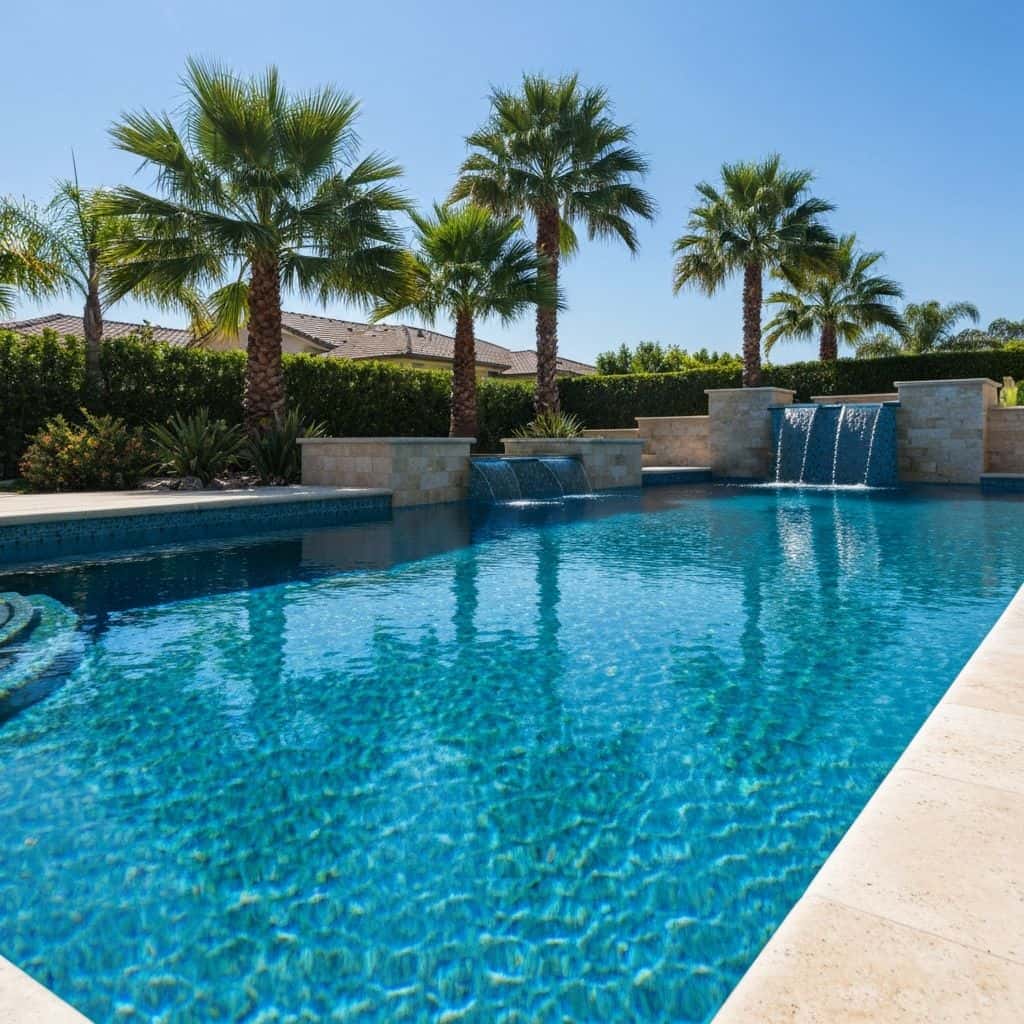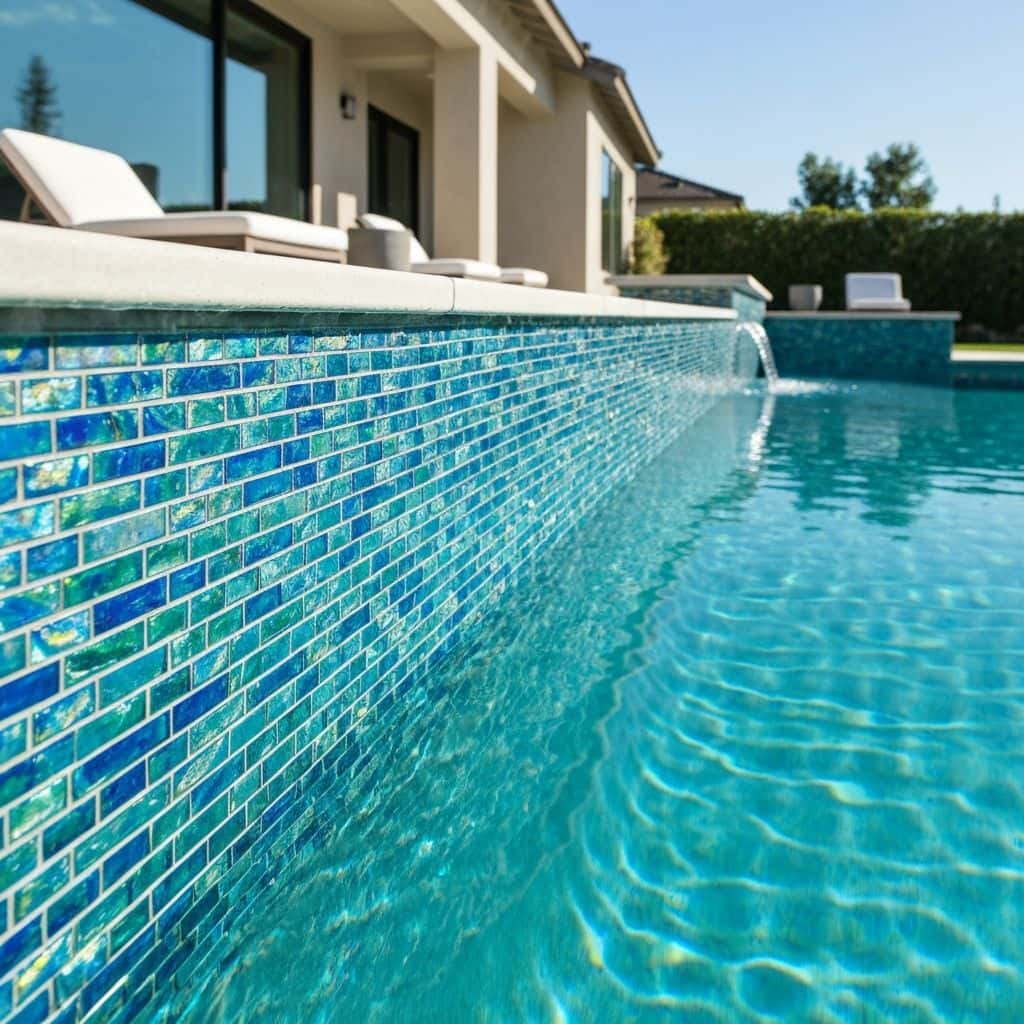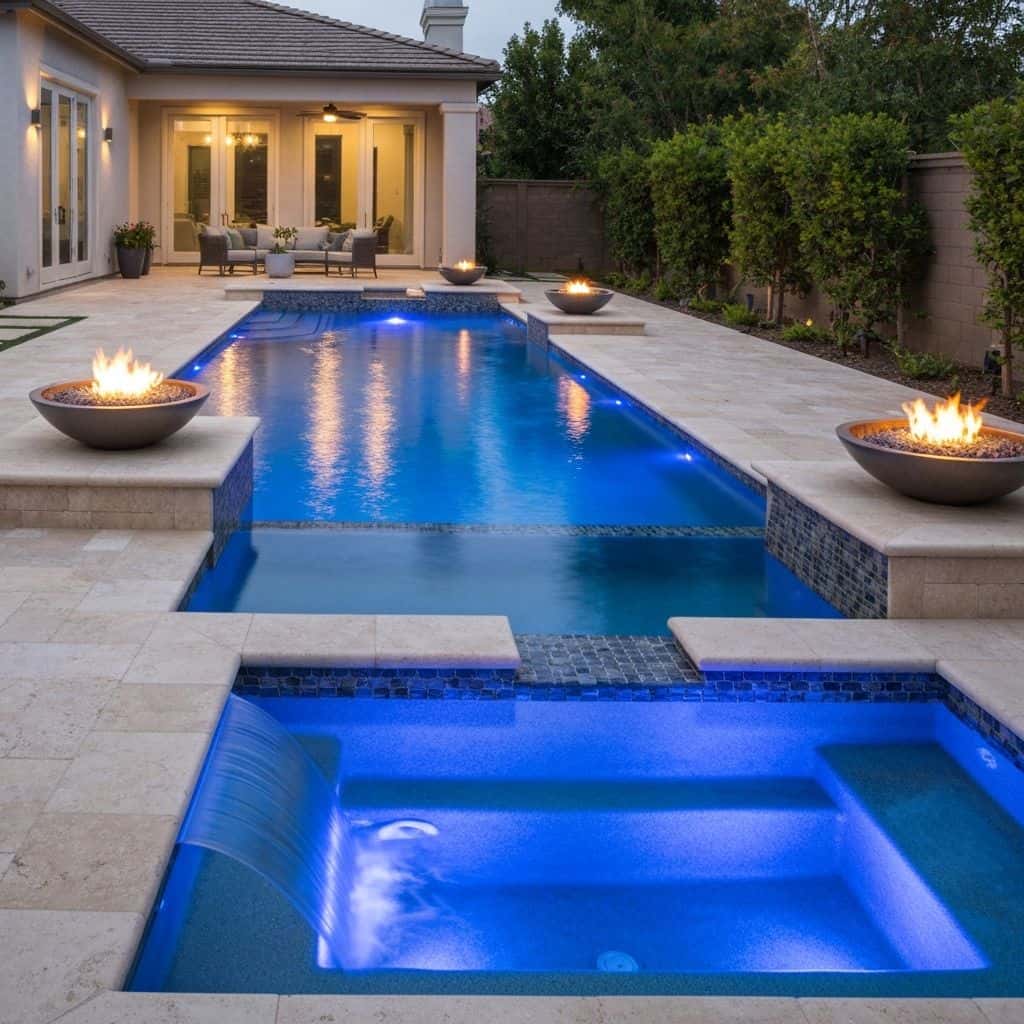

A water feature is a hydraulics decision before it is a design decision. A 24-inch sheer descent needs roughly 30 to 45 gallons per minute at the lip to throw a clean, unbroken sheet. Starve it and you get a dribble down the wall. Installed, expect $1,500 to $3,500 for a sheer descent, $1,200 to $3,000 for a scupper, $900 to $1,600 for a bubbler and $2,500 to $4,500 for a lit laminar jet. The differences that matter are flow, noise and wind.
Sheer descents: width, flow and the wind problem
Sheer descents come in 12, 18, 24, 36 and 48-inch lip widths. Budget 15 to 20 gallons per minute per foot of width to keep the sheet solid: a 24-inch unit wants 30 to 45 GPM, a 48-inch unit 60 to 80 GPM. That is real flow, and it is why a single-speed pump asked to run one 48-inch descent alongside filtration always disappoints.
Drop height drives noise. At 8 to 12 inches above the waterline a descent murmurs. At 18 to 24 inches it is loud enough to mask traffic from the 101 or the 405, which is the actual reason many Studio City and Sherman Oaks clients want one.
Wind is the failure mode nobody plans for. Within a few miles of the coast in Malibu or Corona del Mar, the afternoon onshore breeze shreds a thin sheet sideways. Specify a thicker lip, push flow to the top of the range, and keep the drop under 12 inches.
Pro Tip
Ask to see the feature running at the flow your pump will actually deliver, not at the manufacturer's maximum.
Scuppers and raised-wall spillways
A scupper is a spout set into a raised wall or bond beam that discharges into the pool. Installed with facing stone, budget $1,200 to $3,000 each. Cast bronze and copper spouts patina and suit the Spanish and Mediterranean houses of Pasadena and San Marino; brushed stainless suits flat-roofed modern work in the Hollywood Hills.
The cost is not really in the spout. It is in the wall. A raised bond beam has to be structural: steel tied into the pool shell, its own footing where the wall stands independent, and a waterproofing membrane behind any stone veneer. Skip the membrane and the veneer effloresces and delaminates within two or three seasons.
Flow per scupper is modest at 10 to 25 GPM, so three or four in a wall is achievable on a normally sized pump. Space them 24 to 36 inches on centre and keep the outlet 6 to 10 inches above the waterline.
Ready to Start Your Project?
Schedule a free consultation with our design team.
Bubblers, deck jets and laminar jets
Bubblers sit in a tanning ledge or entry step and push a low dome of water 6 to 18 inches high. They are the quietest feature on the list, they read beautifully when lit, and they cost $900 to $1,600 installed plus $400 to $700 for an integrated LED. Each draws 15 to 25 GPM.
Deck jets are simple arcing streams from the deck into the pool at $600 to $1,200 each installed. Cheap, splashy, and in any real breeze they water the coping instead of the pool.
Laminar jets are the expensive version: a smooth glass-like rod of water with an LED down the centre, $2,500 to $4,500 each installed. They need clean, pulse-free flow, so they belong on a dedicated line, and they must be set dead level or the arc lands off target. Three laminars across a raised wall is the standard arrangement.
Plumbing: the part that decides whether it works
Run every water feature on its own valved line back to the equipment pad, in 2-inch pipe minimum for anything above 40 GPM. Sharing the pool's return line means the feature only runs when filtration runs, at whatever flow is left over after the returns take their share.
The better arrangement is a dedicated feature pump. A 1.65 total horsepower variable-speed pump costs $1,100 to $1,800 for the unit plus $400 to $900 to install and wire, and it lets you dial each feature to its correct flow independently of the filter cycle. California appliance efficiency standards have effectively made variable speed the only pool pump on the market at that size, so you get speed control regardless.
Put a three-way valve at the pad for each feature group and label it. Balancing a scupper wall through one shared valve is guesswork; balancing it with individual valves takes ten minutes.
Evaporation, chemistry and running costs
Aeration is what a water feature does, and that has consequences.
Falling and splashing water drives off carbon dioxide, which raises pH. Run a large sheer-descent wall daily and expect to add muriatic acid noticeably more often. Hold total alkalinity toward the lower end of the normal range, around 80 to 100 ppm, so pH moves less between visits.
Evaporation climbs as well. A wide sheer descent running several hours a day through a San Fernando Valley August measurably increases make-up water. An autofill valve is $600 to $1,200 installed and stops the level dropping below the skimmer throat, which is where pumps get damaged.
Energy is modest if you plan it. A variable-speed feature pump at feature speed draws far less than an old single-speed unit forced to run the whole system. Schedule the features around when the yard is used, not around the filtration cycle.
Final Thoughts
Pick features for what you want out of them. Noise masking means a sheer descent with real drop and real flow. Quiet sparkle on a tanning ledge means bubblers. Architecture means a scupper wall built properly, with steel and waterproofing behind the stone. Whatever you choose, plumb it on a dedicated line and a dedicated pump. That is the difference between a feature you run and one you switch on twice a year.
Frequently Asked Questions
Plan 15 to 20 gallons per minute for every foot of lip width. A 24-inch unit needs 30 to 45 GPM, a 36-inch unit 45 to 60 GPM, and a 48-inch unit 60 to 80 GPM. Below those figures the sheet breaks into strands partway down and the feature looks like a leak rather than a design element.
A sheer descent with an 18 to 24 inch drop, by a wide margin. That is exactly why people on busy streets in Studio City or Costa Mesa specify one. Deck jets come next, scuppers are moderate, and bubblers are close to silent. If the goal is a quiet yard, keep drops under 12 inches.
Bubblers and scuppers can, provided there is a ledge or a raised wall to receive them. The plumbing is the cost: trenching a new feature line from the equipment pad usually runs $1,500 to $4,000 on its own before the feature itself. Do it during a remodel while the deck is already open and the pool is drained.
Yes, in three ways. Aeration raises pH so acid demand increases. Evaporation rises, so an autofill becomes worth having. And in hard Southern California water, calcium scale builds on the lip of a sheer descent or scupper and needs periodic wiping. None of it is onerous, but it is not zero.