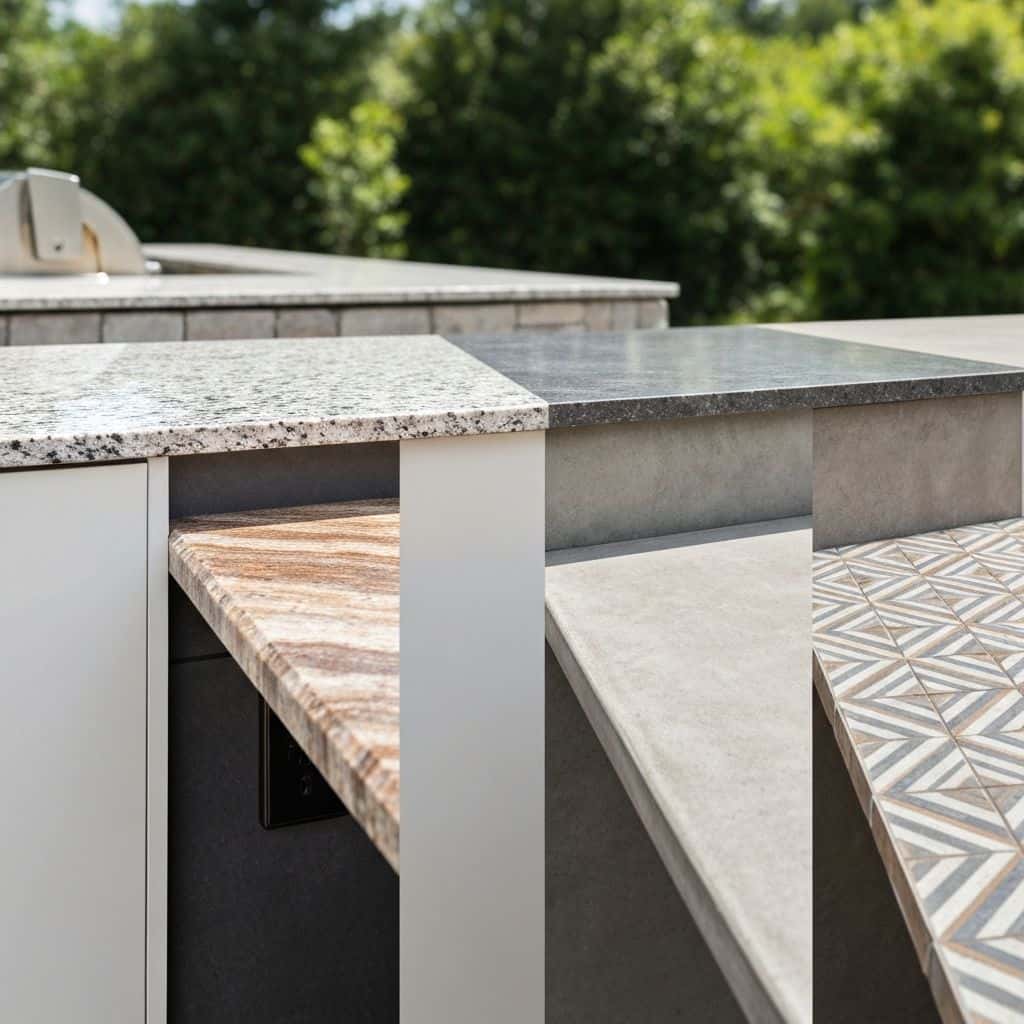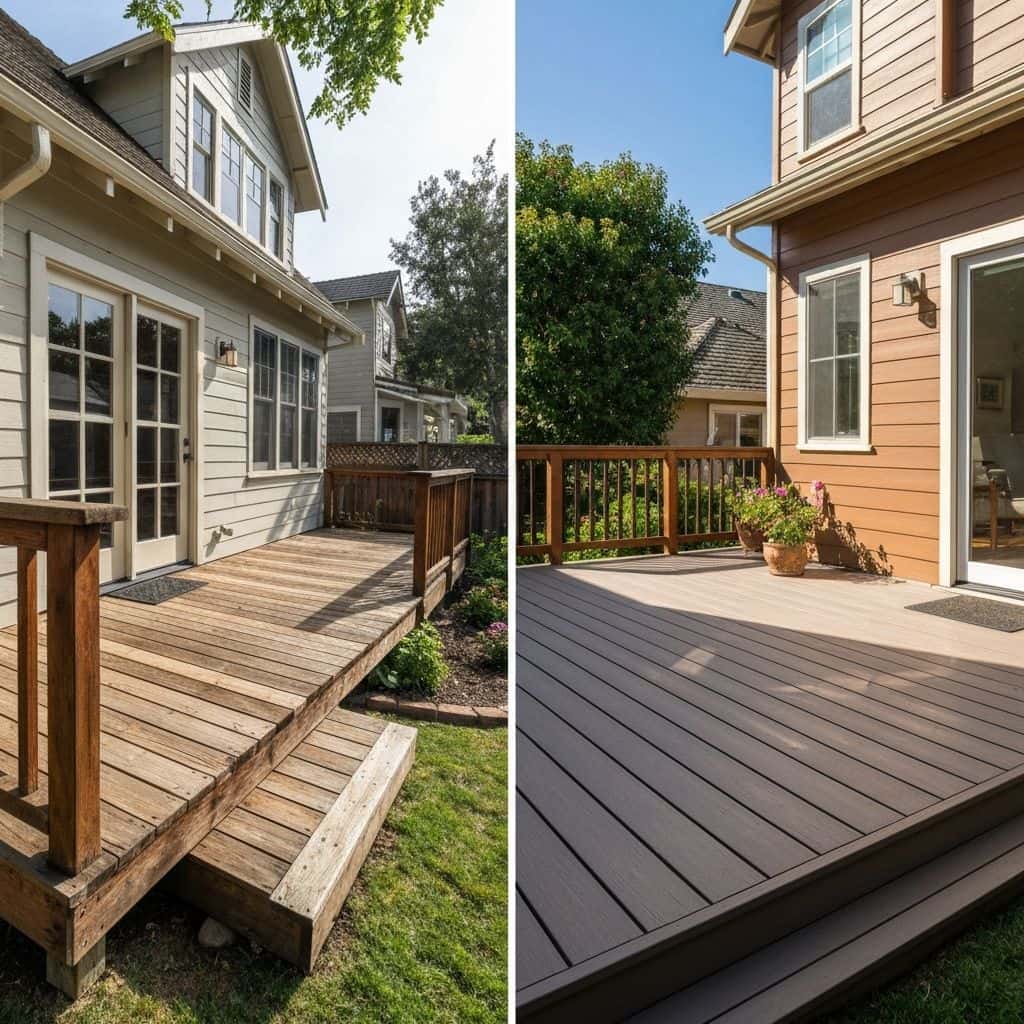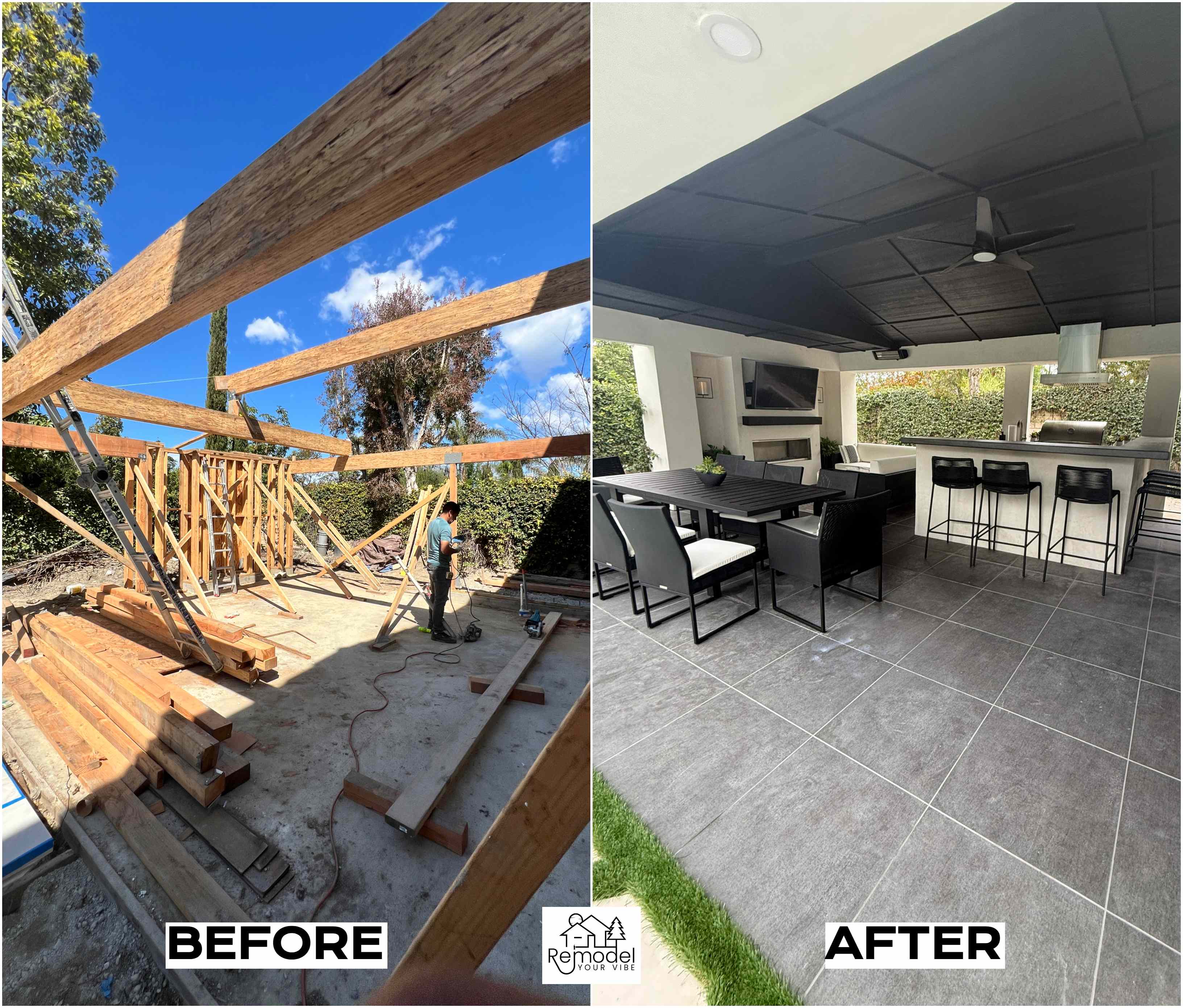
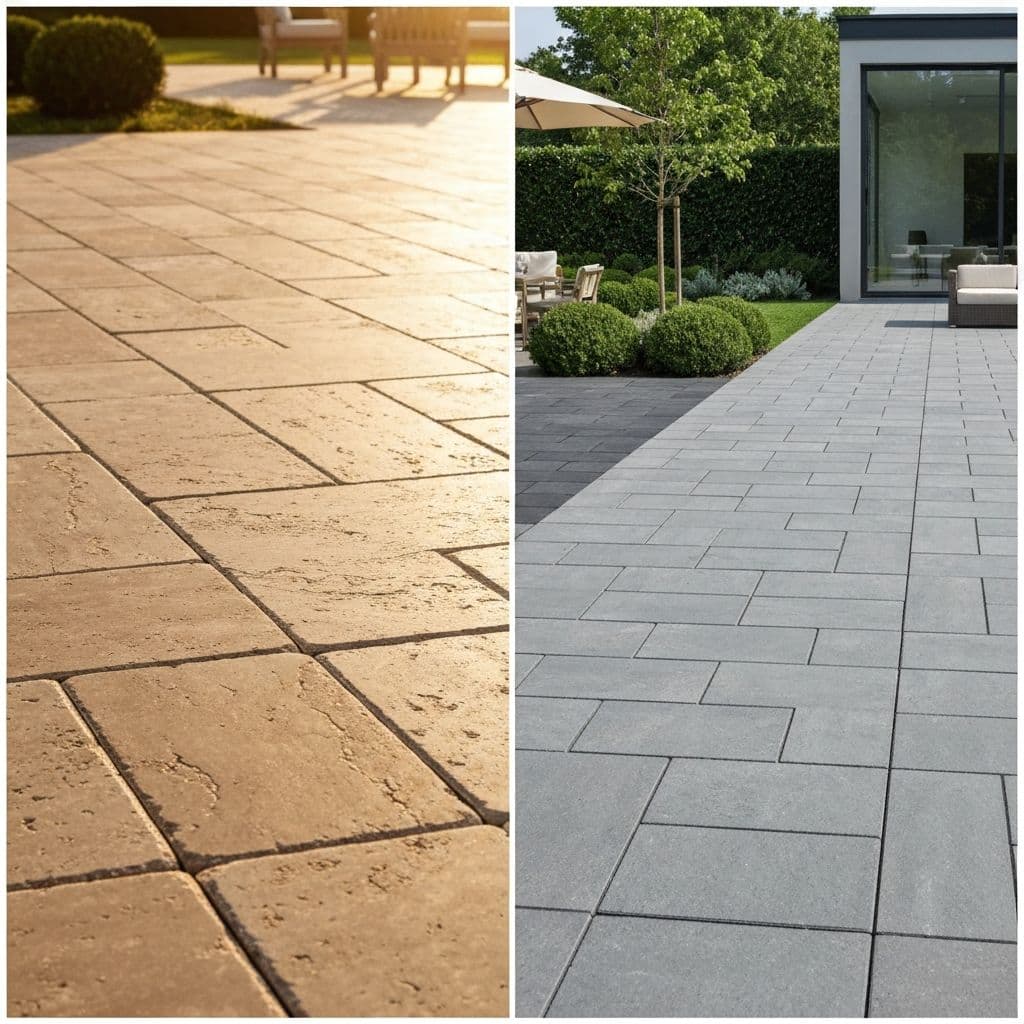
Installed, travertine pavers run about $22 to $30 per square foot in Southern California. Porcelain pavers run about $24 to $34. On a 900 square foot pool deck that is a difference of roughly $3,600: real money, but not enough to decide the job on its own. What decides it is how each material behaves in Valley heat, next to chlorinated water, in full afternoon sun in Woodland Hills or under salt air in Manhattan Beach. We install both. Here is where each one earns its price.
What each one costs, line by line
On a 900 square foot pool deck in Encino, a travertine install lands around $20,000 to $27,000 and porcelain around $22,000 to $31,000. The line items behind those numbers: 3cm tumbled travertine in a French pattern is $6 to $10 per square foot for material; 2cm porcelain pavers are $9 to $15. Demolition of an existing concrete deck and haul-off adds $3 to $6 per square foot. Four inches of Class II aggregate base compacted in two lifts, plus a one-inch bedding course, runs $5 to $8. Installation labor is $9 to $14 depending on pattern and cut count. Order 10 to 12 percent extra material for waste, more if the deck has radius edges. Travertine carries a sealing cost of $1.50 to $2.50 per square foot at install and again every two to four years. Bullnose coping in either material is priced separately by the lineal foot, $28 to $60.
Pro Tip
Make every bidder price the base separately. A paver quote that never names base depth or compaction is hiding the part of the job that fails first.
Heat, grip and bare feet
Travertine is the cooler surface, and it is not close. It is a porous calcium carbonate stone that stores less heat and wicks moisture off wet feet, which is why it still dominates pool decks from Calabasas to Rancho Santa Fe. Porcelain can match it, but only if the color is light. A charcoal or espresso porcelain paver in full San Fernando Valley sun in August is genuinely too hot to stand on. The same tile in bone or greige is comfortable. Ask every supplier for the wet slip figure: around a pool, specify a textured or structured finish with a wet DCOF of 0.42 or better, and keep polished and lappato surfaces away from anywhere water lands. Tumbled travertine gives grip naturally. Filled and honed travertine is smoother and belongs on a covered patio rather than on a wet coping edge.
Ready to Start Your Project?
Schedule a free consultation with our design team.
Staining, salt and the ten-year view
Porcelain wins this category outright. Fully vitrified porcelain absorbs under 0.5 percent water, never needs sealing, does not etch when a lime wedge or a splash of muriatic acid lands on it, and holds its color under UV. Travertine is limestone chemistry: acid etches it, red wine and cooking oil stain it, and unsealed stone near a salt chlorine generator can spall as salt crystallizes inside the pores. Sealing manages all of that, but sealing is a recurring cost and a recurring decision. Figure $1.50 to $2.50 per square foot every two to four years. Coastal properties in Dana Point and Hermosa Beach reach that cycle fastest. On the other side, a chipped porcelain paver shows body color if the tile is not through-body, and a cracked one has to be lifted and swapped rather than patched. Both materials outlast stamped concrete by a wide margin.
The two installs are not the same job
Travertine at 3cm is forgiving. It sets on a screeded one-inch sand bed over four inches of compacted Class II base, with a rigid edge restraint and polymeric sand in the joints, and small base imperfections vanish under the thickness of the stone. Porcelain at 2cm is thinner, flatter and far less tolerant. It wants a tighter screed, a 3 to 5mm open joint, and a base that has been proof-rolled. A hollow spot under a large-format tile becomes a crack the first time someone drags a fire table across it. Over an existing slab, porcelain is mortar-set with a large-format exterior thinset and honored movement joints. Over a roof or podium deck it goes on adjustable pedestals. Cutting differs too: travertine cuts fast, porcelain needs a continuous-rim diamond blade and a slow feed, which is part of why porcelain labor prices higher.
Pro Tip
If you are laying 2cm porcelain over an existing concrete deck, every crack in that slab has to be addressed first or it will telegraph straight through.
What we specify, and when
Default to porcelain for driveways, high-traffic entries, coastal lots and modern architecture, provided the color is light and the finish is textured. Default to travertine for large resort-style pool decks where people are barefoot for hours, where the house is Mediterranean or Spanish, and where the owner accepts a sealing cycle. Budget is rarely the deciding factor; the gap on a typical yard is a few thousand dollars set against a $60,000 to $150,000 backyard. Mixing the two is legitimate and we do it often: travertine on the pool deck and coping for comfort underfoot, porcelain on the driveway and side yard for abuse resistance, tied together with a shared color temperature so the yard reads as one scheme. The two combinations we argue against are dark porcelain around a pool and unsealed travertine on a salt system.
Final Thoughts
Neither material is a mistake. Porcelain is the lower-maintenance, higher-durability choice and the right default for driveways, coastal lots and modern homes. Travertine is the cooler, softer, more traditional pool deck and worth its sealing cycle if bare feet are the priority. Bring a sample of each home, leave them in your own yard for a full afternoon, and stand on both at four o'clock.
Frequently Asked Questions
Travertine, in most cases. Its porosity means it stores less heat and dries faster, so it stays noticeably cooler than a comparable porcelain paver. Color closes the gap, though. A light bone or greige porcelain is close to travertine, while a charcoal porcelain in full inland sun is too hot to walk on barefoot in August.
No. Fully vitrified porcelain absorbs under 0.5 percent water, so a penetrating sealer has nothing to penetrate. The only sealing conversation with porcelain is the joint material. Travertine is the opposite: it needs an impregnating sealer at installation and again every two to four years, at roughly $1.50 to $2.50 per square foot each cycle.
Yes, but the specification changes. Driveway porcelain is typically 2cm set in a mortar bed over a properly reinforced concrete slab, or a thicker paver over a deeper compacted base with a heavier edge restraint. It should never be sand-set over a residential deck base and then driven on. Priced correctly, expect $28 to $40 per square foot installed.
Roughly $20,000 to $27,000 in travertine and $22,000 to $31,000 in porcelain, assuming demolition of an existing slab, four inches of compacted Class II base, a bedding course, edge restraint and polymeric sand. Coping, drainage, steps and any retaining work are separate line items and are the usual reason two bids on the same yard differ by $10,000.
It can, but only if it is sealed and kept sealed. Salt crystallizing inside the stone's pores is what causes spalling and pitting at the coping edge. On salt chlorine systems we specify a quality impregnating sealer, a proper expansion joint between coping and deck, and a resealing cycle closer to every two years than every four.