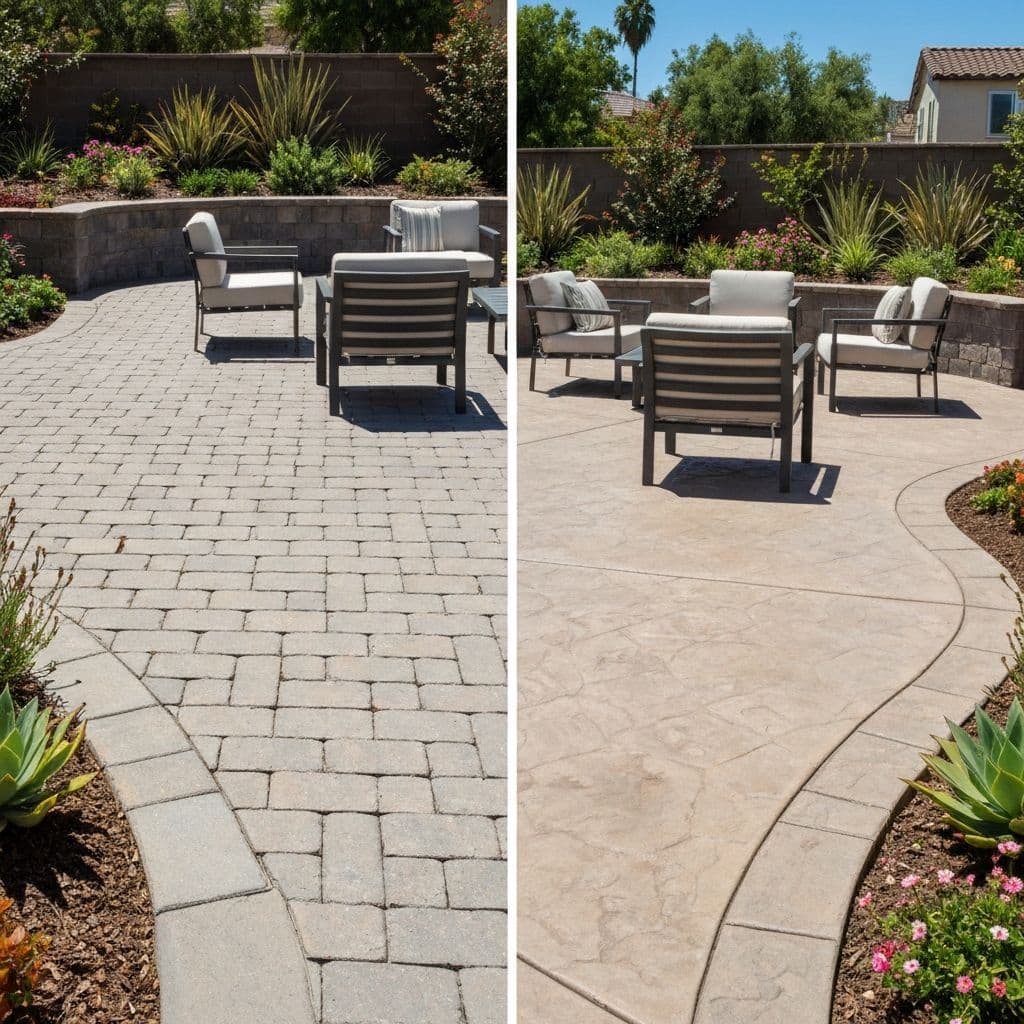
Stamped concrete costs $12 to $22 per square foot installed in Southern California. Pavers cost $18 to $32. On a 700 square foot patio in Yorba Linda that is roughly $8,400 to $15,400 against $12,600 to $22,400. The savings are genuine and the first-day appearance can be close. The difference shows up at year five to ten, when the slab has cracked somewhere it was not supposed to, the color has flattened in the sun, and a patch of the pattern needs to be matched. Here is the full comparison, with specifications.
The real cost of each, with specifications
A stamped concrete patio at $12 to $22 per square foot buys a four-inch slab at 3,000 to 4,000 psi over four inches of compacted base, #3 rebar at 18 inches on center or fiber reinforcement, integral color plus a powdered antique release, and a solvent or water-based sealer. Add $1 to $2 per square foot every two to three years to reseal. Without that, the color chalks. A paver patio at $18 to $32 per square foot buys four to six inches of compacted Class II base, a one-inch bedding course, 60mm units, a rigid edge restraint and polymeric sand joints. Neither number includes demolition ($3 to $6 per square foot), drainage, steps or retaining. Complex layouts, borders and radius work push both toward the top of the range.
Pro Tip
Ask what the slab mix design and rebar layout are in writing. A stamped patio poured on a thin, unreinforced slab is the cheapest bid on the table and the one that cracks first.
Concrete cracks. The only question is where
Concrete shrinks as it cures and moves with temperature. Control joints do not prevent cracking; they decide where the crack lands. Sawcut them within 12 to 24 hours of the pour at eight to twelve feet on center for a four-inch slab, one quarter of the slab depth, and isolate the slab from the house, columns and pool shell with expansion material. Even done correctly, expansive clay soils across parts of the San Fernando Valley and inland Orange County, plus irrigation and tree roots, produce random cracking over time. Pavers have no monolithic surface to crack. They move as individual units on a flexible base, which is exactly why they survive ground movement that fractures a slab. The failure mode for pavers is settlement or joint sand loss, and both are correctable in an afternoon.
Ready to Start Your Project?
Schedule a free consultation with our design team.
What happens when something has to be opened up
This is the argument that ends most of these conversations. Stamped concrete cannot be repaired invisibly. Color is a chemical reaction that varies pour to pour, the release agent weathers, and a stamp mat pressed into fresh concrete next to eight-year-old concrete never matches. A gas line repair, a sewer lateral, a spa relocation or a settled corner means either living with a visible patch or replacing the whole field. Pavers come up and go back down. We lift the units over the trench, stack them, do the work, recompact the base and reset the same pavers with fresh polymeric sand. Ten percent of overstock kept in the side yard covers stains and chips for the life of the patio. On any yard where future utility work is plausible, that flexibility is worth the price difference on its own.
Driveways, heat and heavy loads
For driveways, pavers are the stronger specification. Use 80mm units on a compacted base of six to eight inches for residential vehicles, with a heavy-duty edge restraint at the perimeter; budget roughly $20 to $35 per square foot installed. Point loads spread through the interlock rather than concentrating in one plane, and any settled area can be reset. Stamped concrete driveways in Southern California are a common regret: joints crack, tire tracks wear the pattern flat, oil stains sit in the texture, and turning tires scuff sealer. Surface temperature is a wash. Both get hot, and both get hotter as color goes darker. Around pools, the deciding factors are slip resistance and how the material handles standing chlorinated water, where a textured paver has the edge over a broom-finished sealed slab.
What we recommend
Pavers for driveways, pool decks, and any patio on a house you plan to own for ten years or more. The premium is roughly 40 percent up front and it buys repairability, resistance to ground movement and a surface that still looks intentional at year fifteen. Stamped concrete makes sense in two situations: a genuinely tight budget on a secondary area like a side yard or utility pad, and a homeowner who accepts the resealing cycle. If the appeal is the monolithic modern look rather than the price, skip the stamp entirely. A smooth or lightly sandblasted colored slab with clean sawcut joints on a three-foot or four-foot grid costs about the same as stamping, reads far more contemporary, and ages honestly instead of looking like imitation stone.
Final Thoughts
Stamped concrete saves real money on day one and costs it back in resealing, patching and eventual replacement. Pavers cost more up front and can be lifted, repaired and reset indefinitely. Choose pavers for driveways, pool decks and long-term homes. If concrete is the answer for budget or style, pour a clean modern slab with proper joints rather than stamping a pattern that will not age well.
Frequently Asked Questions
Yes, by roughly 30 to 40 percent up front. Stamped concrete runs $12 to $22 per square foot installed in Southern California against $18 to $32 for pavers. Factor in resealing every two to three years at $1 to $2 per square foot, plus the likelihood of visible patching or replacement after a decade, and the lifetime gap narrows considerably.
Eventually, yes. Concrete shrinks as it cures and moves with soil and temperature. Correctly sawcut control joints at eight to twelve feet on center steer cracking into the joints, but expansive clay soils, irrigation and tree roots still produce random cracks over time. It is a material characteristic, not a workmanship defect, though thin, unreinforced slabs crack far sooner.
Not invisibly. Concrete color varies between pours, release agents weather, and a stamp mat pressed into new concrete beside aged concrete never matches. Crack filling and a color-coat resurfacing can improve appearance, but the repair remains visible at an angle in daylight. Full replacement is often the only result a homeowner is genuinely satisfied with.
Pavers, in almost every case. Specify 80mm units over six to eight inches of compacted base with a heavy-duty edge restraint, roughly $20 to $35 per square foot installed. The interlock spreads vehicle point loads, settled sections can be reset, and stained units can be swapped. Stamped concrete driveways crack at joints and wear flat in the tire tracks.
A properly built paver field lasts 25 years or more with occasional resetting and joint sand top-ups, because the units themselves do not wear out. Stamped concrete typically looks its best for five to eight years, then needs recoloring or resurfacing, and is often replaced somewhere between years twelve and twenty depending on soil movement and sun exposure.