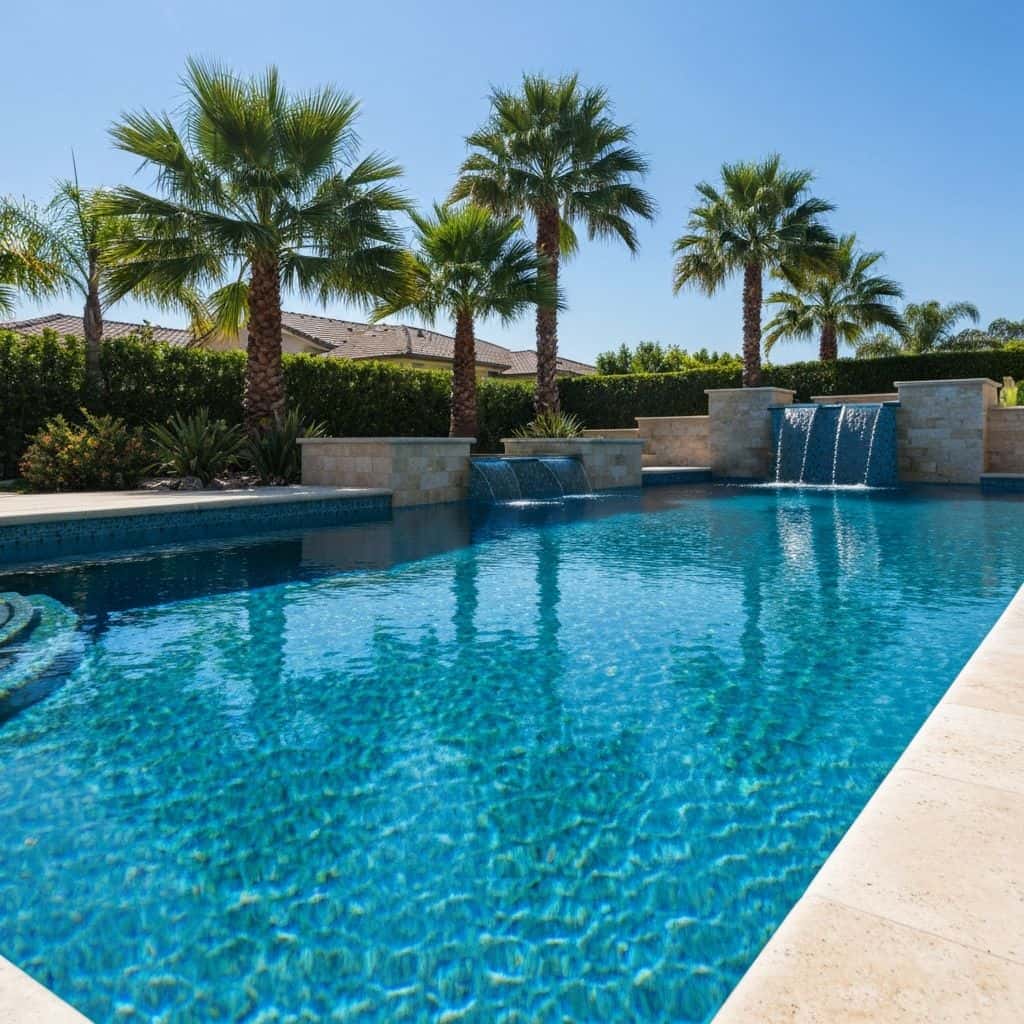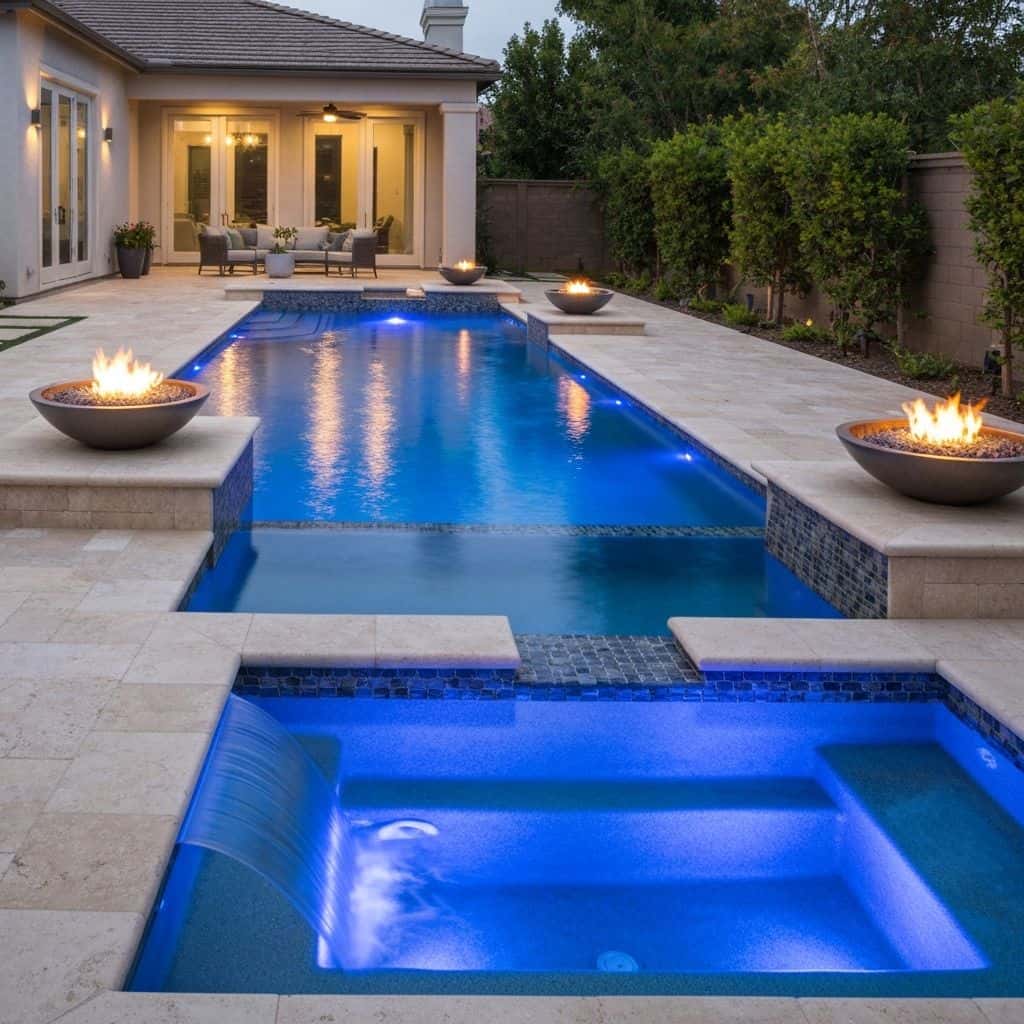
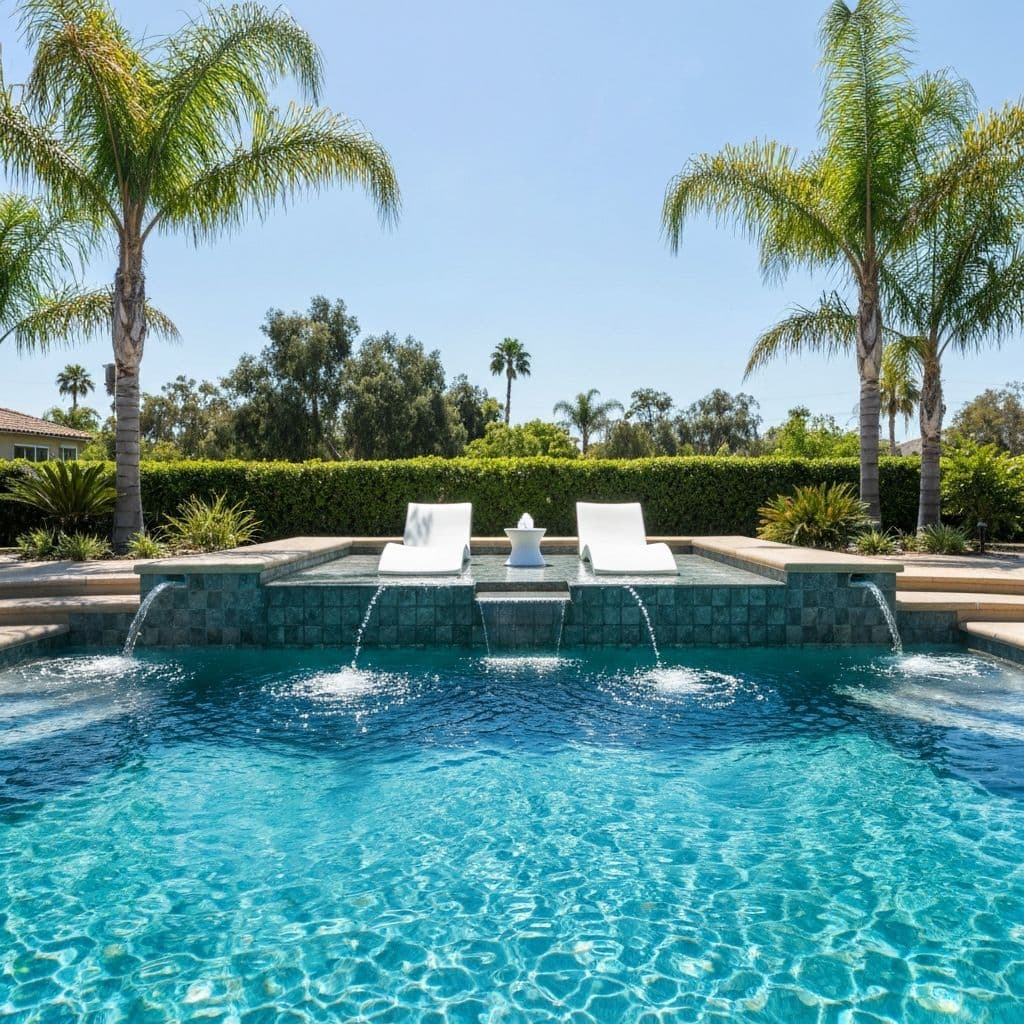
Build a tanning ledge with 11 inches of water over it. Shallower and it overheats, evaporates and reads as a puddle by August. Deeper and you cannot lie on it. That one dimension decides whether the feature earns its cost. On a new pool in Los Angeles or Orange County, a 6 by 8 foot ledge adds roughly $3,500 to $6,000. Cutting one into an existing shell during a remodel runs $9,000 to $16,000, because the shell, the plumbing and the plaster all get opened up. The rest is detail work.
Depth and dimensions that actually work
Nine to twelve inches of water is the usable band, and 11 inches is the number we default to. A submerged lounger sits properly, a toddler can sit upright, and the water still moves.
Size to furniture, not to instinct. A 6 by 8 foot ledge (48 square feet) holds two in-pool loungers with room to step past. An 8 by 10 (80 square feet) takes two loungers, a side table and two children. Running the ledge the full 16-foot width of a pool at 6 feet deep gives 96 square feet and reads architecturally, which suits the long rectangular pools common in Encino and Newport Beach.
Keep the step from ledge down to the shallow end at 12 inches maximum, with a 4-inch contrasting tile band on the nose so swimmers see the drop. Set the umbrella sleeve, 2.5 or 3 inches inside diameter, in the gunite before plaster. It cannot be added later.
Pro Tip
Position the umbrella sleeve for where the shade falls at four in the afternoon, not at noon.
What a ledge costs, line by line
On a new build the ledge is incremental: extra excavation and gunite, additional steel, more plaster surface, more coping and deck. A 6 by 8 ledge adds $3,500 to $6,000. An 8 by 12 adds $6,000 to $9,000.
Retrofitting into an existing shell is a different job. Expect $9,000 to $16,000, covering saw-cutting the shell, doweling new steel into sound concrete, shooting and curing new gunite, adding a return line, resetting waterline tile and replastering the entire pool. Plaster cannot be patched invisibly, so the whole surface goes.
Add-ons price separately: bubblers $900 to $1,600 each installed, plus $400 to $700 for an integrated LED. Umbrella sleeve $350 to $700. A dedicated valved return $400 to $800.
Since a full pool remodel in Orange County typically runs $15,000 to $45,000, folding a ledge into a scheduled replaster is by far the cheapest route to one.
Ready to Start Your Project?
Schedule a free consultation with our design team.
Finish: what it feels like under bare skin
Standard pebble finishes use roughly 3/8-inch aggregate. Durable, and abrasive. Fine underfoot, unpleasant to lie on for an hour. On a tanning ledge, specify a polished small-aggregate pebble or a quartz-modified plaster instead. Budget $5.50 to $8 per square foot for standard pebble over plaster, $8 to $12 for a polished finish.
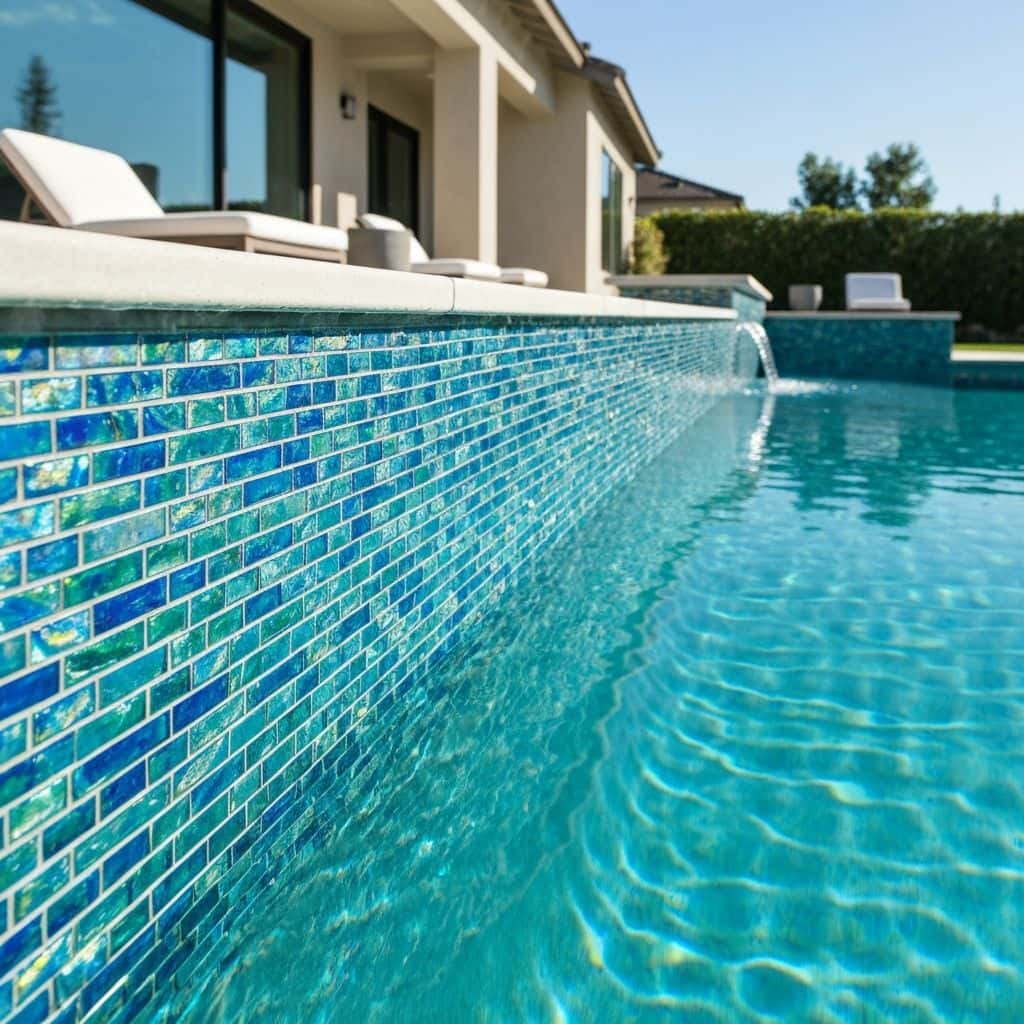
A fully tiled ledge in 1-inch glass mosaic looks the part and costs $35 to $70 per square foot. It also stores heat. In Woodland Hills or Chatsworth a dark glass ledge at one in the afternoon gets uncomfortable at the exposed lip; mid-tone and lighter colours stay usable.
Depth cuts both ways on temperature. Eleven inches of water over a dark finish runs three to six degrees warmer than the main pool body. Welcome in Laguna Beach and Palos Verdes where the marine layer holds pool temperatures down, less welcome in Temecula in July.
Plumbing the ledge so the water moves
Shallow water is where circulation problems show first. Left on the pool's general return pattern, a ledge goes stagnant, grows algae in the corners and burns off chlorine fast under direct sun.
Give it dedicated flow. One return minimum, two on a ledge over 60 square feet, on their own valved line so you can bias flow to the shelf. Point them along the ledge rather than into it.
Bubblers need their own supply. Each wants 15 to 25 gallons per minute at the head; a pair runs comfortably off a single 2-inch line with a valve at the equipment pad. Tee them into the main return on an existing pool with a marginal pump and the whole pool loses circulation whenever they run. On a new build we plumb the feature line back to a dedicated port on a variable-speed pump.
Chemistry follows: hold cyanuric acid at 30 to 50 ppm so the ledge does not strip chlorine by mid-afternoon.
Safety and permitting
A tanning ledge is still water, and 11 inches is enough to drown a small child. California's Swimming Pool Safety Act requires drowning-prevention safety features on new residential pools, and a shelf does not change that obligation. Build in visual cues as well: a contrasting tile band at the drop-off and a defined edge that reads clearly from the deck at dusk.
Suction entrapment matters here too. Do not put an unblockable single suction outlet in a shelf. In practice we simply do not drain from the ledge; it is fed and skimmed as part of the main body.
Permitting is straightforward. In the City of Los Angeles a private single-family pool is reviewed under a combined Building-Mechanical permit at LADBS; the separate plumbing plan check applies to commercial and apartment pools, not single-family homes. Hillside lots also fall under Baseline Hillside Ordinance 184,802, which drives grading and setback review.
Final Thoughts
Get three things right and a tanning ledge becomes the most-used part of the pool: 11 inches of water, a finish you can lie on, and dedicated circulation. Get them wrong and it is a warm, cloudy step nobody sits on. If a replaster is already on the calendar, that is the moment to build it.
Frequently Asked Questions
Nine to twelve inches of water, with 11 inches as the practical default. Below nine inches the water heats aggressively, evaporates quickly and reads as shallow. Above twelve inches an in-pool lounger floats rather than sits, and small children cannot stand comfortably. Measure the shelf floor down from finished water level, not from the top of the coping.
Yes, at $9,000 to $16,000. The shell is saw-cut, new steel is doweled into sound concrete, fresh gunite is shot and cured, a return line is added, and the entire pool is replastered because plaster cannot be patched invisibly. That is why the work belongs inside a planned remodel rather than as a standalone project.
On a new build, usually not, provided the feature line is plumbed back to a dedicated valved port on a variable-speed pump. On a retrofit with an older single-speed pump, running bubblers off the main return starves filtration. Adding a small dedicated variable-speed feature pump costs roughly $1,500 to $2,600 installed and solves it permanently.
Do the arithmetic. In a 12 by 24 pool, a 6 by 8 ledge takes 48 of 288 square feet, about 17 percent of the swim area. If the pool is mainly for lounging and young children, that trade is easily worth it. If lap swimming matters, push the ledge into a shallow-end corner instead of spanning the width.
A polished small-aggregate pebble or a quartz-modified plaster. Standard 3/8-inch pebble is too coarse to lie on. Full glass mosaic looks excellent and costs $35 to $70 per square foot, but choose mid-tone or lighter colours in inland valleys where a dark tiled lip becomes too hot to touch through the afternoon.