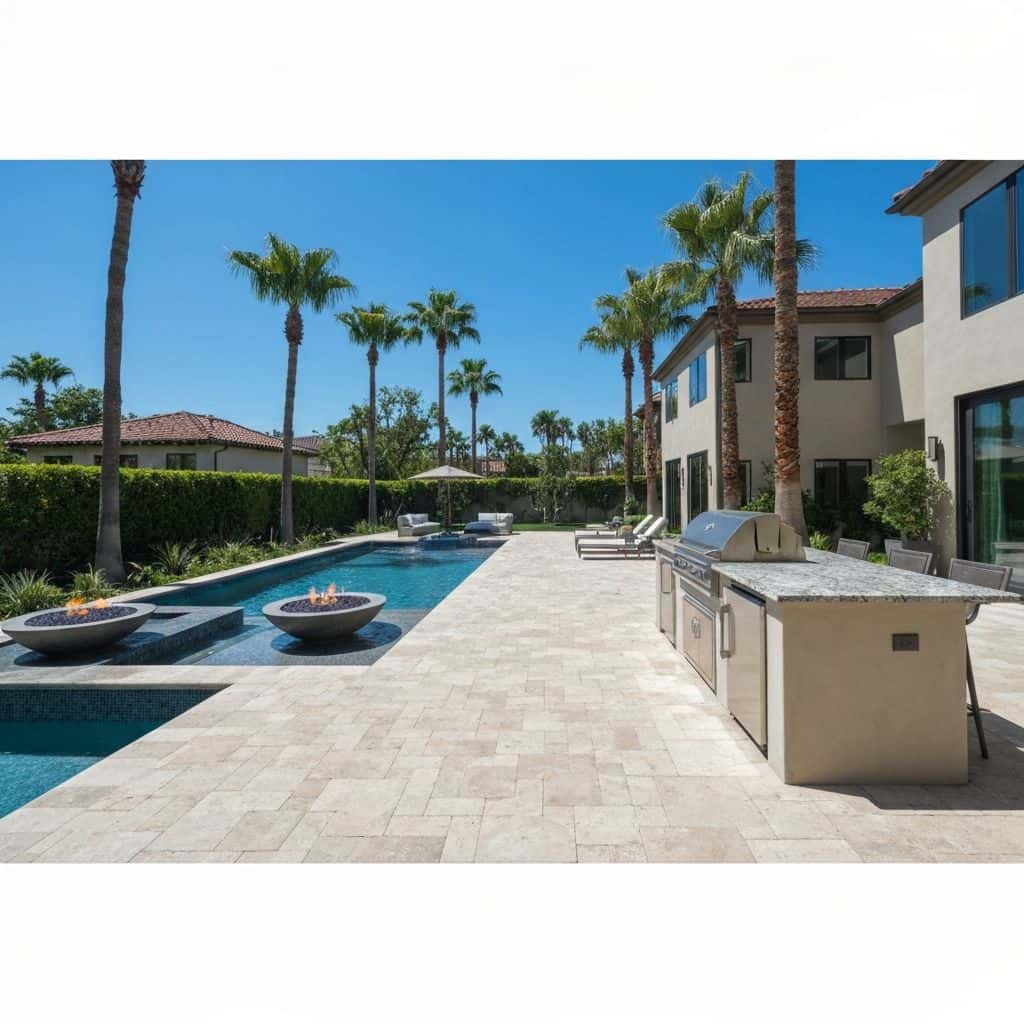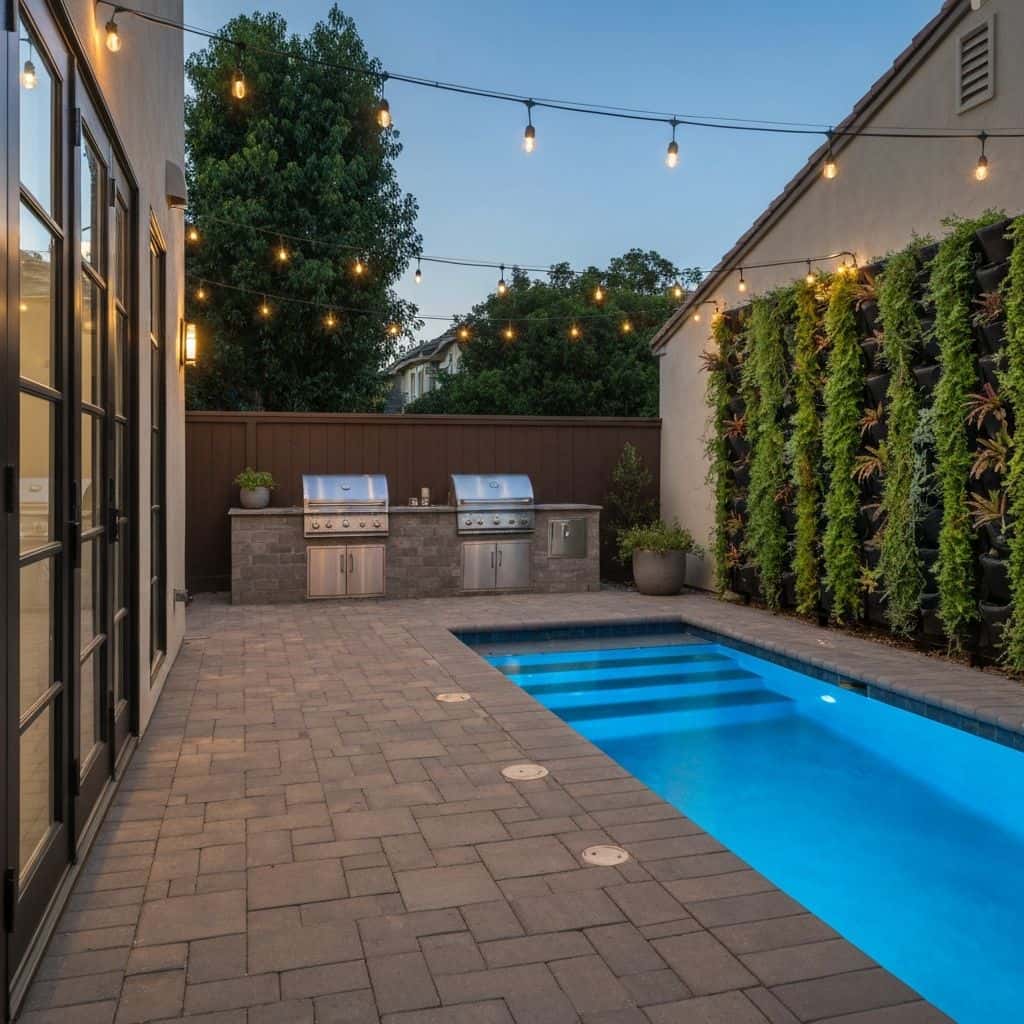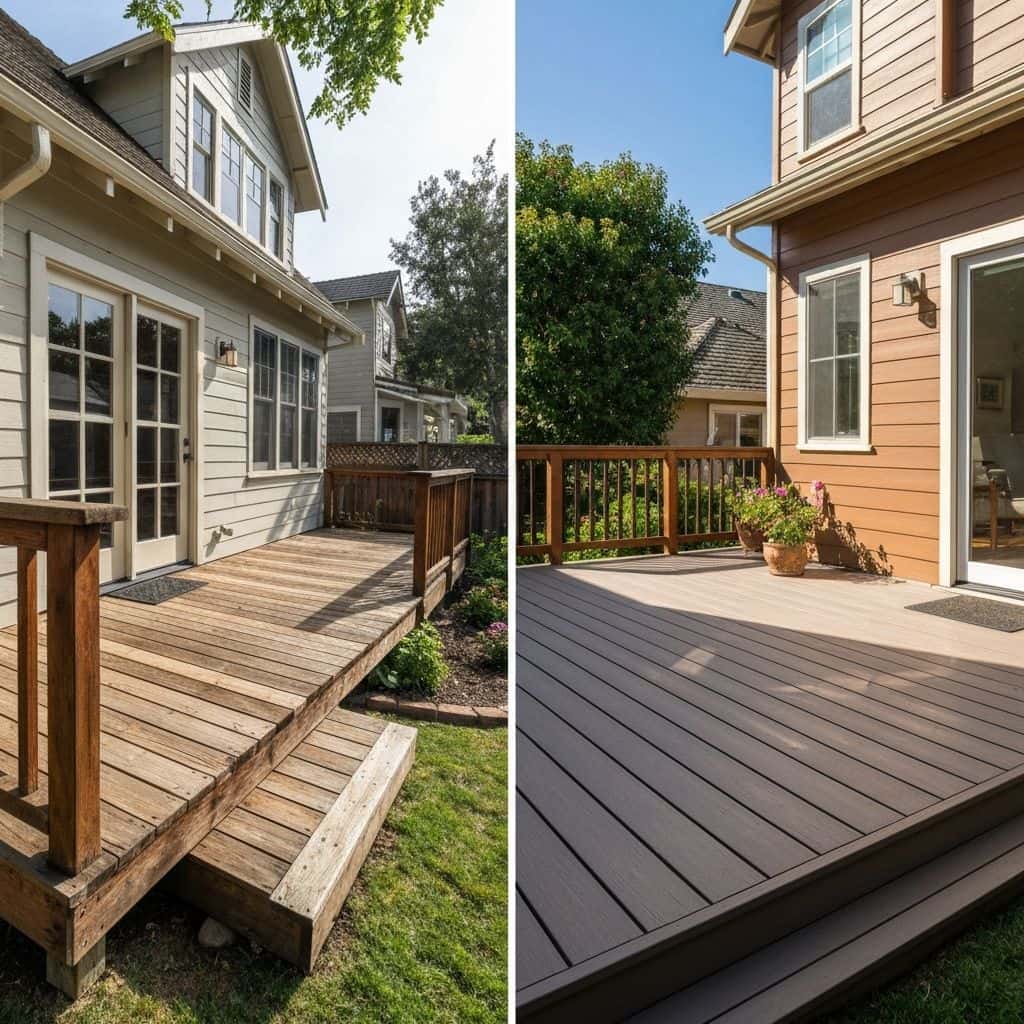
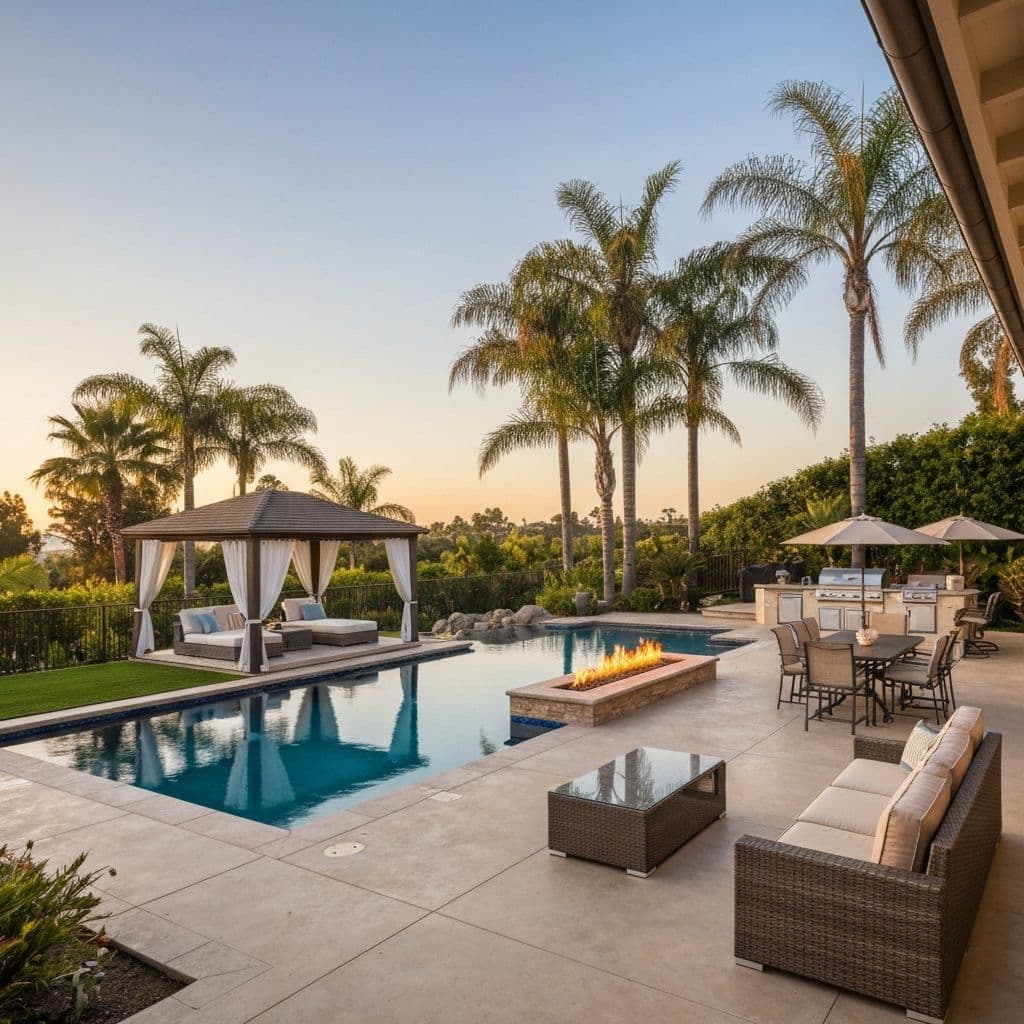
A full backyard build in Huntington Beach runs $55,000 to $180,000, depending on whether you are working a 25 ft wide downtown lot or a 2,000 sq ft tract yard inland of Beach Boulevard. The build itself is ordinary. What is not ordinary is the ground and the air: a shallow water table near the wetlands and downtown, sandy soils that need real compaction discipline, an onshore breeze most afternoons, and salt that destroys the wrong hardware within two seasons. Here is what each of those costs.
What a Huntington Beach backyard costs
Two typical projects frame the range.
A downtown lot, 25 ft x 115 ft with alley access and a 350 to 500 sq ft rear yard: $55,000-$95,000 for paving, a compact covered zone, a small kitchen island, lighting and planting.
A tract yard of 1,500 to 2,500 sq ft: $95,000-$180,000 for a full build with a louvered roof, full outdoor kitchen, fire feature and turf.
Underlying line items:
- Paver patio: $18-$32 per sq ft installed
- Artificial turf: $12-$20 per sq ft installed
- Louvered aluminium roof: $18,000-$40,000 by span
- Outdoor kitchen: $10,000-$15,000 basic island, $30,000-$50,000 full cook suite
- Gas fire pit: $3,500-$12,000
- Landscape lighting: $3,000-$12,000
- Drainage and area drains: $4,000-$11,000
A new pool sits on top at $80,000 to $160,000, more where dewatering is required.
Sandy soil and a shallow water table
Near the wetlands, downtown and toward Sunset Beach, groundwater is close to the surface, and much of the coastal plain is mapped in state seismic hazard zones for liquefaction. Both belong in the budget before a shovel moves.
For a pool, expect a geotechnical report at $4,000 to $9,000, dewatering during excavation and shell cure at $6,000 to $18,000, and a hydrostatic relief valve in the shell floor that has to remain functional permanently. Never fully drain a pool in these neighbourhoods without a plan.
For hardscape, sand drains beautifully and compacts poorly unless confined. Lay a geotextile separation fabric on the sand subgrade, then 4 to 6 in of class II aggregate base in 3 to 4 in lifts compacted to 90 to 95 percent relative compaction, then 1 in maximum of screeded bedding sand.
Pergola footings go deeper and wider in sand: a 24 in diameter by 30 in deep pier where 18 in would do in clay.
Pro Tip
If a paving bid has no geotextile fabric in the scope, it is a settlement claim waiting to happen on sandy ground.
Ready to Start Your Project?
Schedule a free consultation with our design team.
Wind is a daily design input
The onshore sea breeze builds most afternoons here, which is exactly when people want to be outside. Design for it rather than around it.
What that means in practice. Freestanding fabric shade and cantilever umbrellas fail; a louvered aluminium roof engineered for the local exposure does not. Open fire tables west of Pacific Coast Highway blow out and scatter embers. Either fit a tempered glass wind guard at $250 to $700 or build a fireplace with a solid back wall, which is why fireplaces get more use than fire pits on the exposed streets.
Screening should be slatted or glass. A solid wall creates turbulence and a low-pressure eddy on the leeward side, so the seating area behind it stays windy.
And every shade structure needs engineered footings and connection hardware rated for coastal exposure. Stamped calculations add $1,500 to $4,500 and prevent the failure that costs far more.
Materials that last three blocks from the sand
Salt in the air is relentless and it works fastest on the cheapest component in any assembly.
Specify 316 stainless for outdoor kitchen doors, drawer slides, hinges and fasteners. Standard 304 develops surface rust and pitting within a couple of seasons this close to the beach. Structures should be marine-grade powder-coated aluminium, with a proper pretreatment and a two-coat powder system, rather than painted steel.
For paving, through-body porcelain outperforms travertine and limestone, which pit and spall as salt crystallises inside the stone. Landscape light bodies should be solid brass or copper. Shade fabric should be solution-dyed acrylic. Deck fasteners should be stainless, not coated carbon steel.
Avoid raw or galvanised steel anywhere it will get wet and dry repeatedly. Then add a hose bib near the kitchen and equipment, and rinse metal monthly with fresh water. That habit outperforms every coating on the market.
Coastal Zone review and downtown lot constraints
The Coastal Zone covers a large western portion of Huntington Beach, so whether a coastal permit applies comes down to your address. Where the city's certified Local Coastal Program applies, the city administers the permit, with certain decisions remaining appealable to the California Coastal Commission. Confirm parcel status before design, because it changes both the drawing set and the review sequence. Parcels adjoining the Bolsa Chica wetlands carry additional habitat considerations.
Downtown lots bring their own constraints. At 25 ft wide with an alley behind, the yard is narrow, the setbacks are tight and there is little room to stage materials. Deliveries have to be timed rather than stockpiled, and a dumpster usually goes in the alley under a permit.
Building permits still apply to patio covers above the exempt size, gas and electrical for kitchens and fire features, and to pools and spas.
Plants and turf that survive salt wind
Salt-laden wind burns the wrong plants within a season. Species that hold up in exposed Huntington Beach yards include coast rosemary (Westringia fruticosa), rosemary, Coprosma, New Zealand Christmas tree (Metrosideros), Phormium, Leymus condensatus 'Canyon Prince' and Carex pansa as a low-water lawn substitute. Agave attenuata works well when it is set back from direct spray. Bougainvillea belongs on the sheltered, inland side of the house.
Hedge with something salt-tolerant rather than fighting to keep a boxwood alive on the windward boundary.
For artificial turf near the sand, two details matter. Specify a fully permeable backing, not punched holes, and build on 3 to 4 in of compacted class II base. Blowing sand accumulates in the infill and slows drainage over time, so plan on power-brooming quarterly and topping up infill annually. Turf still beats real lawn here for water and appearance, but it is not maintenance-free.
Final Thoughts
Huntington Beach yards fail in three predictable ways: settled paving on poorly compacted sand, wind-wrecked shade structures, and corroded hardware that was specified for an inland lot. All three are avoidable at design stage for a fraction of what they cost to fix. Build the base properly, engineer the structures, specify 316 stainless and porcelain, and the yard will still be right in ten years.
Frequently Asked Questions
A downtown lot with a 350 to 500 sq ft rear yard runs $55,000 to $95,000. A 1,500 to 2,500 sq ft tract yard with a louvered roof, kitchen and fire feature runs $95,000 to $180,000. Add $80,000 to $160,000 for a pool, more where a shallow water table requires dewatering.
Near the wetlands, downtown and toward Sunset Beach, yes. Budget $6,000 to $18,000 for dewatering during excavation and shell cure, plus a geotechnical report at $4,000 to $9,000. The shell needs a hydrostatic relief valve that stays functional for the life of the pool, and it should never be fully drained without a plan.
Because clean sand compacts poorly unless it is confined and the aggregate base migrates into it. The fix is a geotextile separation fabric on the subgrade, 4 to 6 in of class II base placed in 3 to 4 in lifts and compacted to 90 to 95 percent relative compaction, then no more than 1 in of screeded bedding sand.
An engineered louvered aluminium roof with footings and connection hardware rated for coastal exposure. Cantilever umbrellas and freestanding fabric shade do not last. Stamped structural calculations add $1,500 to $4,500 and are cheaper than replacing a failed structure. Use slatted or glass screens rather than solid walls, which create turbulence downwind.
Coast rosemary (Westringia fruticosa), rosemary, Coprosma, Metrosideros, Phormium, Leymus condensatus 'Canyon Prince' and Carex pansa as a lawn substitute all perform on exposed lots. Agave attenuata works set back from direct spray. Keep bougainvillea and other tender material on the sheltered inland side of the house.